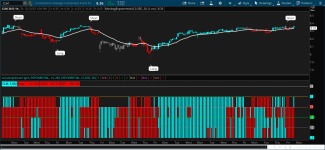
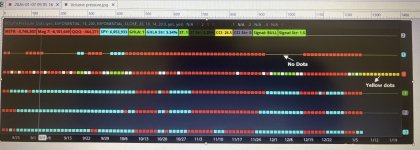
I can tell you haven't used the indicator yet.
 Why include both the Mag7 and QQQ in this indicator?

They aren’t the same thing — even if they’re correlated.
The
Mag7 is a custom aggregation of the seven largest tech stocks (AAPL, MSFT, GOOGL, AMZN, META, TSLA, NVDA) averaged together in the script. QQQ is a
market-cap-weighted ETF made up of the largest 100 Nasdaq stocks — not just those seven.
So:
- Mag7 gives a pure view of mega-cap tech consensus (equal-weighted average of those leaders in the script).
- QQQ gives the broad tech/innovation trend as seen through a real ETF (with heavy—but not exclusive—tech bias).
Even though Mag7
dominate QQQ (around ~38–40%+ of its weighting in real markets), their signals aren’t identical:
✔ Mag7 can diverge from the wider Nasdaq.
✔ QQQ includes semis, software, biotech, etc., beyond the Magnificent 7.
StockCharts
So Mag7 + QQQ together is a way to check both
tech-core leaders and
broader market/tech trend strength.
Does this double-weight tech?

Yes, it
implicitly adds tech bias — but that’s
intentional in the indicator’s design.
— the stated goal is to find confluence of volume pressure across the instrument you’re trading
plus the dominant market drivers (Mag7, QQQ, SPY).
Think of it like:
From a risk-management perspective this
does overweight tech exposure — but that’s the premise of the indicator rather than a coding mistake.
But why compare non-tech stocks (like WMT) to Mag7/QQQ at all?
This is where it gets more subjective — and where your question makes good sense.
There are two distinct analytical goals that people mix up:
1) Correlation/confirmation in short-term trading
Traders will sometimes check a market leader or broad market benchmark
to confirm direction even for unrelated stocks.
Example: If the market and tech leaders are trending down on volume pressure, a weak-relative stock might be less trustworthy to go long. Same in reverse.
This isn’t
fundamentally logical — it’s
practically tactical:
- Traders believe cross-market volume signals reflect risk appetite.
- Broad market strength/weakness tends to influence most stocks (even staples to some degree).
So mag7/QQQ here act as market “context filters” — not as direct predictors of something like WMT.
2) Sector rotation context
If you’re analyzing something like WMT for sector-rotation reasons, then sure — tech weakness
could be relevant (people moving from tech into staples), but that’s a different type of relationship.
✔ Anti-correlation or rotation dynamics matter.
Meaning: if QQQ is weakening
and volume pressure in staples is rising, that’s a different trade signal than QQQ simply being strong with WMT weak.
But the indicator in the thread doesn’t explicitly model rotation or anti-correlation — it only looks for alignment (all signals the same). If the market
is rotating, that alignment won’t happen — and this indicator won’t capture that nuance well.
So what’s the real takeaway?

Including Mag7 + QQQ is not a “mistake.” It’s a deliberate way to layer
pure mega-cap tech direction with
broad tech ETF trend and
overall market (SPY) to filter signals.
But yes — it does inherently overweight tech biases, especially in a market where the Magnificent Seven are dominant.
Therefore — for non-tech stocks like WMT, you might prefer
sector-specific context (e.g., consumer staples indices, sector volume signals, rotation indicators) over tech-centric metrics.
Better alternatives for non-tech context
If your goal is to analyze a stock like Walmart (WMT), consider:
- Volume pressure for sector ETFs (XLP for staples).
- Relative strength vs broad market.
- Momentum/volume signals for the stock itself rather than tech benchmarks.
- Sector rotation indicators (e.g., comparing XLP vs XLK).
That gives you context where tech isn’t dominating the signal.
In short:
The indicator
intentionally layers multiple market views — which gives tech-heavy context rather than neutral analysis. For tech stocks that may be useful; for non-tech it may overemphasize unrelated drivers.
To sum it up, I created this indicator for the way I trade and decided to share it.