
The second quarter of the S&P 500 was up a historic 14% this year. So why did so many day traders struggle?
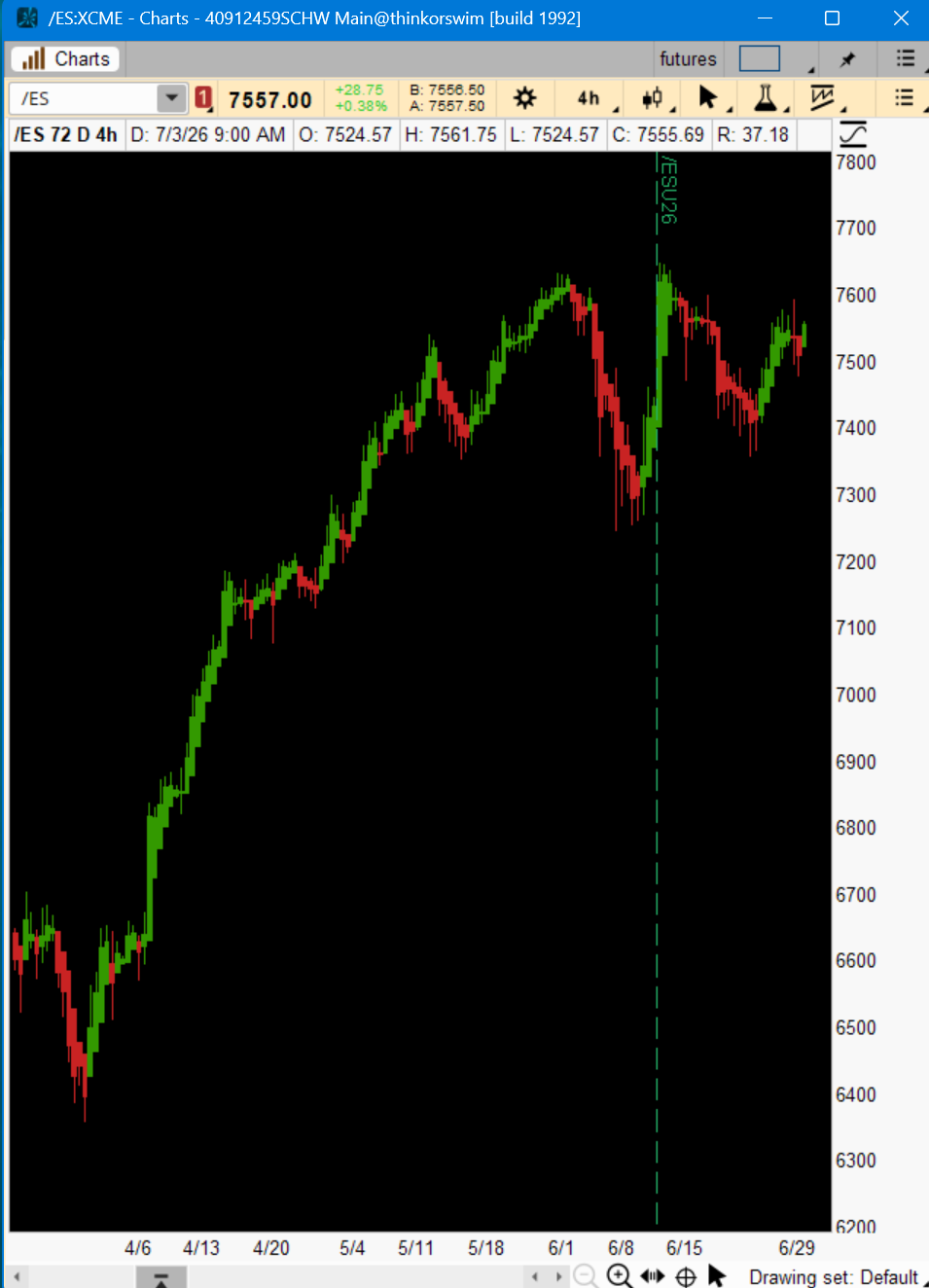
In Q2, there were 35 out of 63 total trading days with strong bullish expansion runs (/ES gains>.04%). That's historic. In a typical bull market, only about 30% of the sessions qualify as strong momentum expansion days.
But this quarter, momentum oscillators such as MACD and RSI dominated roughly 50% of trading sessions.
Momentum traders were rewarded with deep liquidity and clean trends. Where breakouts ran, volume confirmed, and even sloppy execution got rewarded.
Trading momentum during a bullish expansion is like driving a Mustang on a warm, dry race track. Grip is effortless. Acceleration feels limitless. The problem is when it starts raining.
Nothing about the car changed. The road changed.
Markets work the same way. Momentum strategies don't suddenly stop working because MACD broke and is now flashing what novice traders call false signals.
They stopped working because the market environment changed.
The core problem is never the tools.
Indicators, scanners, and watchlists are all built for specific types of market environments. Success requires matching the tool and the specific sector to the environment.
/ES Solution:
TREND EXPANSION
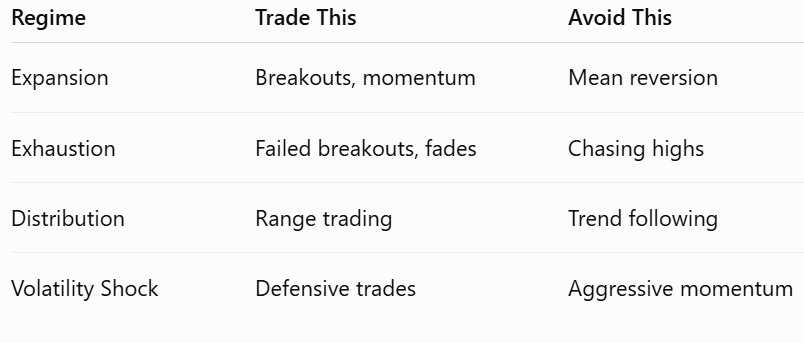
In trend expansion, breakouts follow through. Momentum indicators generate cleaner signals. Trend-following and buying strength generally outperform, and broad participation lifts nearly every risk asset.
EXHAUSTION
In exhaustion, those same breakouts stall and momentum fades, and mean reversion becomes more effective than chasing continuation. Traders shift toward fading extremes and trading established ranges.
DISTRIBUTION
In distribution, the index can continue grinding higher while only a handful of sectors actually participate. During much of 2026, institutional money concentrated on the AI CAPEX builders—custom silicon, HBM memory, and networking infrastructure. Those names produced outsized gains while much of the rest of the market chopped sideways.
Trading the AI CAPEX leaders during the distribution phase required a different approach: range trading. Buy defined support, sell resistance, and scalp volatility inside the box while institutions quietly accumulate.
VOLATILITY
In a volatility shock, unexpected catalysts—hot inflation prints, Treasury auctions, or geopolitical headlines—flip the tape into violent whipsaws. Normally, institutional money rotates toward traditional defensive sectors. During much of 2026, however, money often rotated instead toward AI revenue adopters—companies in logistics, healthcare, industrials, and other mature industries expanding margins through AI deployment rather than AI infrastructure spending. The strategy becomes defensive: reduce position size, widen stops, or simply wait until the tape stabilizes.
CONCLUSION
One reason so many day traders struggled is that they continued applying the same strategy and trading the same stocks, regardless of market regime.
Day trading becomes easier when your vehicle and tools are aligned with the market.
Reading the market environment is a skill developed through deliberate daily practice.
Every morning before running your scanners, ask yourself, what market climate is developing?
Every trading strategy has conditions where it excels and conditions where it struggles.
The edge isn't finding one perfect strategy that works in every market.
The edge is recognizing when the market has changed—knowing when to put the Mustang in the garage and change to a Range Rover before the weather changes.
In Q2, there were 35 out of 63 total trading days with strong bullish expansion runs (/ES gains>.04%). That's historic. In a typical bull market, only about 30% of the sessions qualify as strong momentum expansion days.
But this quarter, momentum oscillators such as MACD and RSI dominated roughly 50% of trading sessions.
Momentum traders were rewarded with deep liquidity and clean trends. Where breakouts ran, volume confirmed, and even sloppy execution got rewarded.
Trading momentum during a bullish expansion is like driving a Mustang on a warm, dry race track. Grip is effortless. Acceleration feels limitless. The problem is when it starts raining.
Nothing about the car changed. The road changed.
Markets work the same way. Momentum strategies don't suddenly stop working because MACD broke and is now flashing what novice traders call false signals.
They stopped working because the market environment changed.
The core problem is never the tools.
Indicators, scanners, and watchlists are all built for specific types of market environments. Success requires matching the tool and the specific sector to the environment.
/ES Solution:
TREND EXPANSION
In trend expansion, breakouts follow through. Momentum indicators generate cleaner signals. Trend-following and buying strength generally outperform, and broad participation lifts nearly every risk asset.
EXHAUSTION
In exhaustion, those same breakouts stall and momentum fades, and mean reversion becomes more effective than chasing continuation. Traders shift toward fading extremes and trading established ranges.
DISTRIBUTION
In distribution, the index can continue grinding higher while only a handful of sectors actually participate. During much of 2026, institutional money concentrated on the AI CAPEX builders—custom silicon, HBM memory, and networking infrastructure. Those names produced outsized gains while much of the rest of the market chopped sideways.
Traders scanning for momentum across the entire market were unknowingly fishing in an empty pond.
Trading the AI CAPEX leaders during the distribution phase required a different approach: range trading. Buy defined support, sell resistance, and scalp volatility inside the box while institutions quietly accumulate.
VOLATILITY
In a volatility shock, unexpected catalysts—hot inflation prints, Treasury auctions, or geopolitical headlines—flip the tape into violent whipsaws. Normally, institutional money rotates toward traditional defensive sectors. During much of 2026, however, money often rotated instead toward AI revenue adopters—companies in logistics, healthcare, industrials, and other mature industries expanding margins through AI deployment rather than AI infrastructure spending. The strategy becomes defensive: reduce position size, widen stops, or simply wait until the tape stabilizes.
CONCLUSION
One reason so many day traders struggled is that they continued applying the same strategy and trading the same stocks, regardless of market regime.
Day trading becomes easier when your vehicle and tools are aligned with the market.
Reading the market environment is a skill developed through deliberate daily practice.
Every morning before running your scanners, ask yourself, what market climate is developing?
FYI: the ToS app provides the real-time NewSquawk.
click on: chat > global news
Highly informative but massive in detail. Traders can use AI tools to summarize high-volume news feeds into actionable alerts.
Every trading strategy has conditions where it excels and conditions where it struggles.
The edge isn't finding one perfect strategy that works in every market.
The edge is recognizing when the market has changed—knowing when to put the Mustang in the garage and change to a Range Rover before the weather changes.
Last edited by a moderator: