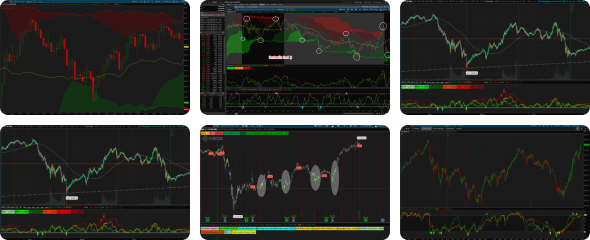

Neural Probability Channel Upper study, Lower study, MTF version study and Watchlist column.
I added clouds, candle color, dark gray inner lines, and divergence for both. This is a 2-hour chart of /NQ.
Original code can be found here. https://www.tradingview.com/script/mFj3oD5h-Neural-Probability-Channel-AlgoPoint/


The Neural Probability Channel (NPC) is a next-generation volatility and trend analysis tool designed to overcome the limitations of traditional bands (like Bollinger Bands) and smoothing filters (like standard Moving Averages).
Unlike traditional indicators that rely on linear deviation or simple averages, the NPC utilizes a Rational Quadratic Kernel—a concept derived from machine learning regression models—to calculate a non-repainting, highly adaptive baseline (Fair Value). This allows the indicator to distinguish between market noise and genuine trend shifts with superior accuracy.
The volatility bands are dynamically calculated using a hybrid of Standard Error (Mean Deviation) and ATR, ensuring the channels adapt organically to market conditions—expanding during high-impact moves and contracting during consolidation.
How It Works
- The Neural Baseline (Center Line): Instead of a standard Moving Average, the NPC uses a Rational Quadratic Kernel weighting system. This assigns "importance" to price data based on both recency and similarity. It acts as a "Center of Gravity" for price, providing a smoother yet responsive trend detection line without the lag associated with SMAs or EMAs.
Crucially, the math is causal (no lookahead), meaning it does not repaint.
Signal Generation:
How to Use It
If price is holding below the baseline and the cloud is red, the trend is Bearish.
- Squeeze Detection: When the Inner and Outer bands compress significantly, it indicates low volatility and often precedes an explosive breakout.
Upper Chart Code:
Lower Chart Code:
MTF Version
Picture of the 5-min chart using 1-hour MTF.

Watchlist Code: Watchlist is based on the upper indicator. It indicates when the high or low is in the buy or sell zones.
I added clouds, candle color, dark gray inner lines, and divergence for both. This is a 2-hour chart of /NQ.
Original code can be found here. https://www.tradingview.com/script/mFj3oD5h-Neural-Probability-Channel-AlgoPoint/
The Neural Probability Channel (NPC) is a next-generation volatility and trend analysis tool designed to overcome the limitations of traditional bands (like Bollinger Bands) and smoothing filters (like standard Moving Averages).
Unlike traditional indicators that rely on linear deviation or simple averages, the NPC utilizes a Rational Quadratic Kernel—a concept derived from machine learning regression models—to calculate a non-repainting, highly adaptive baseline (Fair Value). This allows the indicator to distinguish between market noise and genuine trend shifts with superior accuracy.
The volatility bands are dynamically calculated using a hybrid of Standard Error (Mean Deviation) and ATR, ensuring the channels adapt organically to market conditions—expanding during high-impact moves and contracting during consolidation.
How It Works
- The Neural Baseline (Center Line): Instead of a standard Moving Average, the NPC uses a Rational Quadratic Kernel weighting system. This assigns "importance" to price data based on both recency and similarity. It acts as a "Center of Gravity" for price, providing a smoother yet responsive trend detection line without the lag associated with SMAs or EMAs.
Crucially, the math is causal (no lookahead), meaning it does not repaint.
- Adaptive Volatility Bands: The channel width is not fixed. It uses a Hybrid Volatility Model:
- Inner Channel: Represents the "Probability Zone" (approx. 70% confidence). Price staying here indicates a stable trend.
- Outer Channel: Represents "Extreme Deviation" (Statistical Anomalies). When price touches or breaches these outer bands, it is statistically overextended (Overbought/Oversold).
Signal Generation:
- Reversion Signals: Generated when price breaches the Outer Bands and closes back inside. This suggests a "Snap-back" or Mean Reversion event.
- Trend Confirmation: The color of the baseline and the fill zones changes based on the slope of the Kernel, giving an instant visual read on market bias.
How to Use It
- Mean Reversion Strategy: Look for price action extending beyond the Outer Bands (Thinner lines). If price leaves a wick and closes back inside, it signals a high-probability reversal toward the Neural Baseline.
- Green Signal: Potential Long (Reversal from Lows).
- Red Signal: Potential Short (Reversal from Highs).
- Trend Following: Use the Neural Baseline (Thick Center Line) as a dynamic support/resistance level.
If price is holding below the baseline and the cloud is red, the trend is Bearish.
- Squeeze Detection: When the Inner and Outer bands compress significantly, it indicates low volatility and often precedes an explosive breakout.
Upper Chart Code:
Code:
# ------------------------------------------------------------
# Neural Probability Channel(NPC) [AlgoPoint]
# Original code found at https://www.tradingview.com/script/mFj3oD5h-Neural-Probability-Channel-AlgoPoint/
# Converted and enhanced by Chewie 2/8/2026
# ------------------------------------------------------------

declare upper;

# =========================
# INPUTS
# =========================
input colorbar = yes;
input length = 24;
input h_param = 8.0;
input r_param = 2.0;

input mult_in = 0.65;
input mult_inner = 1.3;
input mult_mid = 1.80;
input mult_outer = 2.6;

# =========================
# COLORS
# =========================
DefineGlobalColor("Bear", CreateColor(242, 54, 69));
DefineGlobalColor("Bull", CreateColor(8, 153, 129));

# =========================
# SOURCE
# =========================
def src = (high + low + close) / 3;

# =========================
# KERNEL REGRESSION (INLINE)
# =========================
def numerator =
    fold k1 = 0 to length
    with acc1 = 0
    do acc1 +
        src[k1] *
        Power(
            1 + Sqr(k1) / (2 * r_param * Sqr(h_param)),
            -r_param
        );

def denominator =
    fold k2 = 0 to length
    with acc2 = 0
    do acc2 +
        Power(
            1 + Sqr(k2) / (2 * r_param * Sqr(h_param)),
            -r_param
        );

def y_hat = numerator / denominator;

# =========================
# VOLATILITY
# =========================
def errorSum =
    fold k3 = 0 to length
    with acc3 = 0
    do acc3 + AbsValue(src[k3] - y_hat);

def meanDeviation = errorSum / length;
def volatility = (meanDeviation + ATR(length)) / 2;

# =========================
# CHANNELS
# =========================
def upperInner1 = y_hat + volatility * mult_inner;
def lowerInner1 = y_hat - volatility * mult_inner;
def upperOuter1 = y_hat + volatility * mult_outer;
def lowerOuter1 = y_hat - volatility * mult_outer;
def uppermid1 = y_hat + volatility * mult_mid;
def lowermid1 = y_hat - volatility * mult_mid;
def uppermidin = y_hat + volatility * mult_in;
def lowermidin = y_hat - volatility * mult_in;

# =========================
# TREND
# =========================
def upTrend = y_hat > y_hat[1];

# =========================
# PLOTS
# =========================
plot Baseline = y_hat;
Baseline.AssignValueColor(if upTrend then GlobalColor("Bull") else GlobalColor("Bear"));
Baseline.SetLineWeight(2);

plot uppermid = uppermidin;
uppermid.setdefaultColor(color.dark_gray);

plot lowermid = lowermidin;
lowermid.setdefaultColor(color.dark_gray);

plot UpperInner = upperInner1;
UpperInner.SetDefaultColor(GlobalColor("Bear"));

plot LowerInner = lowerInner1;
LowerInner.SetDefaultColor(GlobalColor("Bull"));

plot UpperOuter = upperOuter1;
UpperOuter.SetDefaultColor(GlobalColor("Bear"));
UpperOuter.SetLineWeight(2);

plot LowerOuter = lowerOuter1;
LowerOuter.SetDefaultColor(GlobalColor("Bull"));
LowerOuter.SetLineWeight(2);

# =========================
# SIGNALS
# =========================
def buy = if low crosses above lowerOuter then low - ATR(60) / 2 else Double.NaN;
def sell = if high crosses below upperOuter then high + ATR(60) / 2 else Double.NaN;

plot BuySignal = buy;
BuySignal.SetPaintingStrategy(PaintingStrategy.ARROW_UP);
BuySignal.SetDefaultColor(COLOR.CYAN);

plot SellSignal = sell;
SellSignal.SetPaintingStrategy(PaintingStrategy.ARROW_DOWN);
SellSignal.SetDefaultColor(COLOR.MAGENTA);

# =========================
# Clouds
# =========================

AddCloud(lowerinner, lowerouter, Color.dark_green, Color.dark_green);
AddCloud(upperinner, upperouter, Color.dark_red, Color.dark_red);
AddCloud(lowermid1, lowerouter, GlobalColor("Bull"), GlobalColor("Bull"));
AddCloud(uppermid1, upperouter, GlobalColor("Bear"), GlobalColor("Bear"));

# =========================
# Color Bars
# =========================

def bull = close > baseline;
def bear = close < baseline;

AssignPriceColor(if !colorbar then Color.CURRENT else if bull then GlobalColor("Bull") else if bear then GlobalColor("Bear")  else Color.GRAY);
#END OF CODE


#Divergence


# =========================
# VOLATILITY
# =========================

def meanDev = errorSum / length;

# =========================
# NORMALIZED OSCILLATOR
# =========================
def osc = (src - y_hat) / volatility;


input divergenceLength = 20; #hint divergenceLength: The number of bars used to calculate divergences.
def overBought = 1; #hint overbought: The overbought level value.
def overSold = -1; #hint oversold: The oversold level value.
def HALF = 0;
input divergenceType = {default regular, reverse}; #hint divergenceType: The type of divergence. A regular divergence is when price is making higher highs (or lower lows), while the indicator is making lower highs (or higher lows). A reverse divergence (also called a hidden divergence) is when the indicator is making higher highs (or lower lows), while price is making lower highs (or higher lows).
#Hint: The output of this indicator is for informational and educational use only, is not an investment recommendation or advice, and should not be relied upon in making the decision to buy or sell a security or pursue a particular investment strategy.

def xDownBars;
def xUpBars;
def xDowns;
def xUps;
def hiBars;
def loBars;
def pivotTop;
def pivotBottom;
def hiInd;
def loInd;
def hiPrice;
def loPrice;
plot bearish;
plot bullish;

def K = osc;

def ind;
ind = K;

# Bearish
pivotTop =
if
    divergenceType == divergenceType.regular
then
    ind[1] > overBought and ind[1] == Highest(ind, divergenceLength + 1)
else
    ind[1] >= 50 and
    ind[1] == Highest(ind, divergenceLength + 1) and
    ind[1] == Highest(ind, divergenceLength + 1)[-divergenceLength + 1];

if pivotTop
then {
    hiBars = 1;
    hiInd = ind[1];
    hiPrice = Max(high[2], Max(high[1], high[0]));
}
else {
    hiBars = hiBars[1] + 1;
    hiInd = hiInd[1];
    hiPrice = hiPrice[1];
}

if ind[1] crosses below overBought
then {
    xDownBars = 1;
    xDowns = xDowns[1] + 1;
}
else {
    xDownBars = xDownBars[1] + 1;
    xDowns = if pivotTop[1] then 0 else xDowns[1];
}

def bearCond;
switch (divergenceType) {
case regular:
    bearCond =
    ind[1] >= HALF and
    ind < ind[1] and
    high[1] == Highest(high, divergenceLength + 1) and
    hiBars[1] > xDownBars[1] and
    xDowns == 1 and
    close < close[1] and
    hiPrice[1] < high[1] and
    hiInd[1] > ind[1];
case reverse:
    bearCond =
    ind[1] >= HALF and
    ind < ind[1] and
#    high[1] == Highest(high, divergenceLength) and
#    hiBars[1] > xDownBars[1] and
#    xDowns == 1 and
    close < close[1] and
    hiPrice[1] > high[1] and hiPrice[1] > high and
    hiInd[1] < ind[1];
}

bearish =
    if
        bearCond
    then
        high[1]
    else
        Double.NaN;
;

bearish.SetPaintingStrategy(PaintingStrategy.ARROW_DOWN);
bearish.SetDefaultColor(Color.GRAY);
bearish.SetLineWeight(3);
bearish.HideTitle();
bearish.HideBubble();

def countBear = if bearCond[-1] then countBear[1] + 1 else countBear[1];
def recentBear = countBear == HighestAll(countBear);
def secHigh = HighestAll(if bearCond[-1] and recentBear then ind else Double.NaN);
#def firstHigh = highestAll(if bearCond and recentBear and ind[1] == secHigh then hiInd[1] else double.NaN);
def FH_bar = HighestAll(if recentBear and bearCond[-1] and ind == secHigh then GetValue(BarNumber(), hiBars) else Double.NaN);

plot bearTrendline =
if recentBear and
     bearCond[-1] and ind == secHigh
then
    Max(high[1], high[0])
else
#    if pivotTop and hiInd == firstHigh
    if
        FH_bar == BarNumber()
    then
        high
    else
        Double.NaN;
bearTrendline.EnableApproximation();
bearTrendline.SetDefaultColor(Color.RED);
bearTrendline.SetLineWeight(3);
bearTrendline.HideBubble();
bearTrendline.HideTitle();

#Bullish
pivotBottom =
if
    divergenceType == divergenceType.regular
then
    ind[1] < overSold and ind[1] == Lowest(ind, divergenceLength + 1)
else
    ind[1] <= 50 and
    ind[1] == Lowest(ind, divergenceLength + 1) and
    ind[1] == Lowest(ind, divergenceLength + 1)[-divergenceLength + 1];

if pivotBottom
then {
    loBars = 1;
    loInd = ind[1];
    loPrice = Min(low[2], Min(low[1], low[0]));
}
else {
    loBars = loBars[1] + 1;
    loInd = loInd[1];
    loPrice = loPrice[1];
}

if ind[1] crosses above overSold
then {
    xUpBars = 1;
    xUps = xUps[1] + 1;
}
else {
    xUpBars = xUpBars[1] + 1;
    xUps = if pivotBottom[1] then 0 else xUps[1];
}

def bullCond;
switch (divergenceType){
case regular:
    bullCond =
    ind[1] <= HALF and
    ind > ind[1] and
    low[1] == Lowest(low, divergenceLength + 1) and
    loBars[1] > xUpBars[1] and
    xUps == 1 and
    close > close[1] and
    loPrice[1] > low[1] and
    loInd[1] < ind[1];
case reverse:
    bullCond =
    ind[1] <= HALF and
    ind > ind[1] and
#    low[1] == Lowest(low, divergenceLength) and
#    loBars[1] > xUpBars[1] and
#    xUps == 1 and
    close > close[1] and
    loPrice[1] < low[1] and loPrice[1] < low and
    loInd[1] > ind[1];
}

bullish =
    if
        bullCond
    then
        low[1]
    else
        Double.NaN;

bullish.SetPaintingStrategy(PaintingStrategy.ARROW_UP);
bullish.SetDefaultColor(Color.GRAY);
bullish.SetLineWeight(3);
bullish.HideTitle();
bullish.HideBubble();

def countBull = if bullCond[-1] then countBull[1] + 1 else countBull[1];
def recentBull = countBull == HighestAll(countBull);
def secLow = HighestAll(if bullCond[-1] and recentBull then ind else Double.NaN);
#def firstLow = highestAll(if bullCond and recentBull and ind[1] == secLow then loInd[1] else double.NaN);
def FL_bar = HighestAll(if recentBull and bullCond[-1] and ind == secLow then GetValue(BarNumber(), loBars) else Double.NaN);

plot bullTrendline =
    if
        recentBull and bullCond[-1] and ind == secLow
    then
        Min(low[1], low[0])
    else
        if
#            pivotBottom and loInd == firstLow
            FL_bar == BarNumber()
        then
            low[0]
        else
            Double.NaN;
bullTrendline.EnableApproximation();
bullTrendline.SetDefaultColor(Color.GREEN);
bullTrendline.SetLineWeight(3);
bullTrendline.HideBubble();
bullTrendline.HideTitle();
Lower Chart Code:
Code:
# ------------------------------------------------------------
# Neural Probability Channel (PNC) – LOWER STUDY
# Assembled by Chewie 2/8/2026
# ------------------------------------------------------------

declare lower;

# =========================
# INPUTS
# =========================
input length = 24;
input h_param = 8.0;
input r_param = 2.0;

input mult_in = 0.65;
input mult_inner = 1.3;
input mult_mid = 1.80;
input mult_outer = 2.6;

# =========================
# COLORS
# =========================
DefineGlobalColor("Bear", CreateColor(242, 54, 69));
DefineGlobalColor("Bull", CreateColor(8, 153, 129));
DefineGlobalColor("Neutral", Color.DARK_GRAY);

# =========================
# SOURCE
# =========================
def src = (high + low + close) / 3;

# =========================
# KERNEL REGRESSION
# =========================
def numerator =
    fold k1 = 0 to length
    with acc1 = 0
    do acc1 +
        src[k1] *
        Power(1 + Sqr(k1) / (2 * r_param * Sqr(h_param)), -r_param);

def denominator =
    fold k2 = 0 to length
    with acc2 = 0
    do acc2 +
        Power(1 + Sqr(k2) / (2 * r_param * Sqr(h_param)), -r_param);

def y_hat = numerator / denominator;

# =========================
# VOLATILITY
# =========================
def errorSum =
    fold k3 = 0 to length
    with acc3 = 0
    do acc3 + AbsValue(src[k3] - y_hat);

def meanDev = errorSum / length;
def volatility = (meanDev + ATR(length)) / 2;

# =========================
# NORMALIZED OSCILLATOR
# =========================
def osc = (src - y_hat) / volatility;

# =========================
# LEVELS
# =========================
plot ZeroLine = 0;
ZeroLine.AssignValueColor(if osc > 0 then GlobalColor("Bull") else GlobalColor("Bear"));

plot UpperIn  =  mult_in;
plot LowerIn  = -mult_in;

plot UpperInner =  mult_inner;
plot LowerInner = -mult_inner;

def UpperMid =  mult_mid;
def LowerMid = -mult_mid;

plot UpperOuter =  mult_outer;
plot LowerOuter = -mult_outer;

UpperIn.SetDefaultColor(GlobalColor("Neutral"));
LowerIn.SetDefaultColor(GlobalColor("Neutral"));

UpperInner.SetDefaultColor(GlobalColor("Bear"));
LowerInner.SetDefaultColor(GlobalColor("Bull"));

#UpperMid.SetDefaultColor(GlobalColor("Bear"));
#LowerMid.SetDefaultColor(GlobalColor("Bull"));

UpperOuter.SetDefaultColor(GlobalColor("Bear"));
LowerOuter.SetDefaultColor(GlobalColor("Bull"));

UpperOuter.SetLineWeight(2);
LowerOuter.SetLineWeight(2);

# =========================
# OSCILLATOR PLOT
# =========================
plot Oscillator = osc;
Oscillator.AssignValueColor(
    if osc > 0 then GlobalColor("Bull") else GlobalColor("Bear")
);
Oscillator.SetLineWeight(2);

# =========================
# SIGNALS
# =========================
plot BuySignal = if osc crosses above -mult_outer then -mult_outer else double.nan;
BuySignal.SetPaintingStrategy(PaintingStrategy.ARROW_UP);
BuySignal.SetDefaultColor(color.cyan);

plot SellSignal = if osc crosses below mult_outer then mult_outer else double.nan;
SellSignal.SetPaintingStrategy(PaintingStrategy.ARROW_DOWN);
SellSignal.SetDefaultColor(color.magenta);

# =========================
# CLOUDS
# =========================
AddCloud(Lowermid, LowerOuter, GlobalColor("Bull"), GlobalColor("Bull"));
AddCloud(Uppermid, UpperOuter, GlobalColor("Bear"), GlobalColor("Bear"));

AddCloud(lowerinner, lowerouter, Color.DARK_GREEN, Color.DARK_GREEN);
AddCloud(upperinner, upperouter, Color.DARK_RED, Color.DARK_RED);
AddCloud(oscillator, zeroline, Color.DARK_GREEN, Color.DARK_red);


# DIVERGENCE

input divergenceLength = 20; #hint divergenceLength: The number of bars used to calculate divergences.

input divergenceType = {default regular, reverse}; #hint divergenceType: The type of divergence. A regular divergence is when price is making higher highs (or lower lows), while the indicator is making lower highs (or higher lows). A reverse divergence (also called a hidden divergence) is when the indicator is making higher highs (or lower lows), while price is making lower highs (or higher lows).
#Hint: The output of this indicator is for informational and educational use only, is not an investment recommendation or advice, and should not be relied upon in making the decision to buy or sell a security or pursue a particular investment strategy.

def xDownBars;
def xUpBars;
def xDowns;
def xUps;
def hiBars;
def loBars;
def pivotTop;
def pivotBottom;
def hiInd;
def loInd;
def hiPrice;
def loPrice;
plot bearishd;
plot bullishd;

def K = Oscillator;
def Over_Boughta = upperinner;
def Over_Solda = lowerinner;


def ind;
ind = k;

# Bearish
pivotTop =
if
    divergenceType == divergenceType.regular
then
    ind[1] > over_Boughta and ind[1] == Highest(ind, divergenceLength + 1)
else
    ind[1] >= 50 and
    ind[1] == highest(ind, divergenceLength + 1) and
    ind[1] == highest(ind, divergenceLength+1)[-divergenceLength+1];

if pivotTop
then {
    hiBars = 1;
    hiInd = ind[1];
    hiPrice = max(high[2], max(high[1], high[0]));
}
else {
    hiBars = hiBars[1] + 1;
    hiInd = hiInd[1];
    hiPrice = hiPrice[1];
}

if ind[1] crosses below  Over_Boughta
then {
    xDownBars = 1;
    xDowns = xDowns[1] + 1;
}
else {
    xDownBars = xDownBars[1] + 1;
    xDowns = if pivotTop[1] then 0 else xDowns[1];
}

def bearCond;
switch (divergenceType) {
case regular:
bearCond =
    ind[1] >= ZeroLine and
    ind < ind[1] and
    high[1] == Highest(high, divergenceLength + 1) and
    hiBars[1] > xDownBars[1] and
    xDowns == 1 and
    close < close[1] and
    hiPrice[1] < high[1] and
    hiInd[1] > ind[1];
case reverse:
bearCond =
    ind[1] >= ZeroLine and
    ind < ind[1] and
#    high[1] == Highest(high, divergenceLength) and
#    hiBars[1] > xDownBars[1] and
#    xDowns == 1 and
    close < close[1] and
    hiPrice[1] > high[1] and hiPrice[1] > high and
    hiInd[1] < ind[1];}

bearishd =
    if
        bearCond
    then
        ind[1]
    else
        Double.NaN;;

bearishd.SetPaintingStrategy(PaintingStrategy.ARROW_DOWN);
bearishd.SetDefaultColor(Color.light_gray);
bearishd.setLineWeight(2);
bearishd.hideTitle();
bearishd.hideBubble();

def countBear = if bearCond[-1] then countBear[1] + 1 else countBear[1];
def recentBear = countBear == HighestAll(countBear);
def secHigh = highestAll(if bearCond[-1] and recentBear then ind else Double.NaN);
#def firstHigh = highestAll(if bearCond and recentBear and ind[1] == secHigh then hiInd[1] else double.NaN);
def FH_bar = highestAll(if recentBear and bearCond[-1] and ind == secHigh then getvalue(barNumber(), hibars) else double.NaN);

plot bearTrendline =
if
    recentBear and bearCond[-1] and ind == secHigh
then
    max(ind[1], ind[0])
else
#    if pivotTop and hiInd == firstHigh
    if
        FH_bar == barNumber()
    then
        ind
    else
        double.NaN;
bearTrendline.EnableApproximation();
bearTrendline.setDefaultColor(color.RED);
bearTrendline.setLineWeight(4);
bearTrendline.hideBubble();
bearTrendline.hideTitle();

#Bullish
pivotBottom =
if
    divergenceType == divergenceType.regular
then
    ind[1] < over_Solda and ind[1] == lowest(ind, divergenceLength + 1)
else
    ind[1] <= 50 and
    ind[1] == lowest(ind, divergenceLength+1) and
    ind[1] == lowest(ind, divergenceLength+1)[-divergenceLength+1];

if pivotBottom
then {
    loBars = 1;
    loInd = ind[1];
    loPrice = min(low[2], min(low[1], low[0]));
}
else {
    loBars = loBars[1] + 1;
    loInd = loInd[1];
    loPrice = loPrice[1];
}

if ind[1] crosses above over_Solda
then {
    xUpBars = 1;
    xUps = xUps[1] + 1;
}
else {
    xUpBars = xUpBars[1] + 1;
    xUps = if pivotBottom[1] then 0 else xUps[1];
}

def bullCond;
switch (divergenceType){
case regular:
bullCond =
    ind[1] <= ZeroLine and
    ind > ind[1] and
    low[1] == Lowest(low, divergenceLength + 1) and
    loBars[1] > xUpBars[1] and
    xUps == 1 and
    close > close[1] and
    loPrice[1] > low[1] and
    loInd[1] < ind[1];
case reverse:
bullCond =
    ind[1] <= ZeroLine and
    ind > ind[1] and
#    low[1] == Lowest(low, divergenceLength) and
#    loBars[1] > xUpBars[1] and
#    xUps == 1 and
    close > close[1] and
    loPrice[1] < low[1] and loPrice[1] < low and
    loInd[1] > ind[1];}

bullishd =
    if
        bullCond
    then
        ind[1]
    else
        Double.NaN;

bullishd.SetPaintingStrategy(PaintingStrategy.ARROW_UP);
bullishd.SetDefaultColor(Color.light_gray);
bullishd.setLineWeight(2);
bullishd.HideTitle();
bullishd.HideBubble();

def countBull = if bullCond[-1] then countBull[1] + 1 else countBull[1];
def recentBull = countBull == HighestAll(countBull);
def secLow = highestAll(if bullCond[-1] and recentBull then ind else Double.NaN);
#def firstLow = highestAll(if bullCond and recentBull and ind[1] == secLow then loInd[1] else double.NaN);
def FL_bar = highestAll(if recentBull and bullCond[-1] and ind == secLow then getvalue(barNumber(), lobars) else double.NaN);

plot bullTrendline =
    if
        recentBull and bullCond[-1] and ind == secLow
    then
        min(ind[1], ind[0])
    else
        if
#            pivotBottom and loInd == firstLow
            FL_bar == barNumber()
        then
            ind[0]
        else
            double.NaN;
bullTrendline.EnableApproximation();
bullTrendline.setDefaultColor(color.GREEN);
bullTrendline.setLineWeight(4);
bullTrendline.hideBubble();
bullTrendline.hideTitle();

#END CODE
MTF Version
Picture of the 5-min chart using 1-hour MTF.
Code:
# ------------------------------------------------------------
# Neural Probability Channel(NPC) [AlgoPoint]
# Original code found at https://www.tradingview.com/script/mFj3oD5h-Neural-Probability-Channel-AlgoPoint/
# Converted and enhanced by Chewie 2/8/2026
# ------------------------------------------------------------

declare upper;

# =========================
# INPUTS
# =========================
input htf = AggregationPeriod.FIVE_MIN;
input colorbar = no;
input inner = YES;
input length = 24;
input h_param = 8.0;
input r_param = 2.0;

input mult_in = 0.65;
input mult_inner = 1.3;
input mult_mid = 1.80;
input mult_outer = 2.6;

# =========================
# COLORS
# =========================
DefineGlobalColor("Bear", CreateColor(242, 54, 69));
DefineGlobalColor("Bull", CreateColor(8, 153, 129));

# =========================
# SOURCE
# =========================
def High  = high(period = htf);
def Low   = low(period = htf);
def Close = close(period = htf);
def src   = (High + Low + Close) / 3;


# =========================
# KERNEL REGRESSION (INLINE)
# =========================
def numerator =
    fold k1 = 0 to length
    with acc1 = 0
    do acc1 +
        src[k1] *
        Power(
            1 + Sqr(k1) / (2 * r_param * Sqr(h_param)),
            -r_param
        );

def denominator =
    fold k2 = 0 to length
    with acc2 = 0
    do acc2 +
        Power(
            1 + Sqr(k2) / (2 * r_param * Sqr(h_param)),
            -r_param
        );

def y_hat = numerator / denominator;

# =========================
# VOLATILITY
# =========================
def errorSum     = fold k3 = 0 to length with acc3 = 0
                   do acc3 + AbsValue(src[k3] - y_hat);
def meanDeviation = errorSum / length;
def tr_htf = TrueRange(High, Close, Low);
def atr_htf = CompoundValue(1, (atr_htf[1] * (length - 1) + tr_htf) / length, tr_htf);
def volatility = (meanDeviation + atr_htf) / 2;

# =========================
# CHANNELS
# =========================
def upperInner1 = y_hat + volatility * mult_inner;
def lowerInner1 = y_hat - volatility * mult_inner;
def upperOuter1 = y_hat + volatility * mult_outer;
def lowerOuter1 = y_hat - volatility * mult_outer;
def uppermid1 = y_hat + volatility * mult_mid;
def lowermid1 = y_hat - volatility * mult_mid;
def uppermidin = y_hat + volatility * mult_in;
def lowermidin = y_hat - volatility * mult_in;

# =========================
# TREND
# =========================
def upTrend = y_hat > y_hat[1];

# =========================
# PLOTS
# =========================
plot Baseline = y_hat;
Baseline.AssignValueColor(if upTrend then GlobalColor("Bull") else GlobalColor("Bear"));
Baseline.SetLineWeight(3);

plot uppermid = if inner then uppermidin else double.nan;
uppermid.setdefaultColor(color.gray);

plot lowermid = if inner then lowermidin else double.nan;
lowermid.setdefaultColor(color.gray);

plot UpperInner = upperInner1;
UpperInner.SetDefaultColor(GlobalColor("Bear"));

plot LowerInner = lowerInner1;
LowerInner.SetDefaultColor(GlobalColor("Bull"));

plot UpperOuter = upperOuter1;
UpperOuter.SetDefaultColor(GlobalColor("Bear"));
UpperOuter.SetLineWeight(2);

plot LowerOuter = lowerOuter1;
LowerOuter.SetDefaultColor(GlobalColor("Bull"));
LowerOuter.SetLineWeight(2);

# =========================
# SIGNALS
# =========================

def tr_htf_60 = TrueRange(High, Close, Low);
def atr_signal = CompoundValue(1, (atr_signal[1] * (60 - 1) + tr_htf_60) / 60, tr_htf_60);

def buy  = if Low crosses above lowerOuter then Low - atr_signal / 2 else Double.NaN;
def sell = if High crosses below upperOuter then High + atr_signal / 2 else Double.NaN;

plot BuySignal = buy;
BuySignal.SetPaintingStrategy(PaintingStrategy.ARROW_UP);
BuySignal.SetDefaultColor(COLOR.CYAN);

plot SellSignal = sell;
SellSignal.SetPaintingStrategy(PaintingStrategy.ARROW_DOWN);
SellSignal.SetDefaultColor(COLOR.MAGENTA);

# =========================
# Clouds
# =========================

AddCloud(lowerinner, lowerouter, Color.dark_green, Color.dark_green);
AddCloud(upperinner, upperouter, Color.dark_red, Color.dark_red);
AddCloud(lowermid1, lowerouter, GlobalColor("Bull"), GlobalColor("Bull"));
AddCloud(uppermid1, upperouter, GlobalColor("Bear"), GlobalColor("Bear"));

# =========================
# Color Bars
# =========================

def bull = close > baseline;
def bear = close < baseline;

AssignPriceColor(if !colorbar then Color.CURRENT else if bull then GlobalColor("Bull") else if bear then GlobalColor("Bear")  else Color.GRAY);
#END OF CODE


#Divergence


# =========================
# VOLATILITY
# =========================

def meanDev = errorSum / length;

# =========================
# NORMALIZED OSCILLATOR
# =========================
def osc = (src - y_hat) / volatility;


input divergenceLength = 20; #hint divergenceLength: The number of bars used to calculate divergences.
def overBought = 1; #hint overbought: The overbought level value.
def overSold = -1; #hint oversold: The oversold level value.
def HALF = 0;
input divergenceType = {default regular, reverse}; #hint divergenceType: The type of divergence. A regular divergence is when price is making higher highs (or lower lows), while the indicator is making lower highs (or higher lows). A reverse divergence (also called a hidden divergence) is when the indicator is making higher highs (or lower lows), while price is making lower highs (or higher lows).
#Hint: The output of this indicator is for informational and educational use only, is not an investment recommendation or advice, and should not be relied upon in making the decision to buy or sell a security or pursue a particular investment strategy.

def xDownBars;
def xUpBars;
def xDowns;
def xUps;
def hiBars;
def loBars;
def pivotTop;
def pivotBottom;
def hiInd;
def loInd;
def hiPrice;
def loPrice;
plot bearish;
plot bullish;

def K = osc;

def ind;
ind = K;

# Bearish
pivotTop =
if
    divergenceType == divergenceType.regular
then
    ind[1] > overBought and ind[1] == Highest(ind, divergenceLength + 1)
else
    ind[1] >= 50 and
    ind[1] == Highest(ind, divergenceLength + 1) and
    ind[1] == Highest(ind, divergenceLength + 1)[-divergenceLength + 1];

if pivotTop
then {
    hiBars = 1;
    hiInd = ind[1];
    hiPrice = Max(high[2], Max(high[1], high[0]));
}
else {
    hiBars = hiBars[1] + 1;
    hiInd = hiInd[1];
    hiPrice = hiPrice[1];
}

if ind[1] crosses below overBought
then {
    xDownBars = 1;
    xDowns = xDowns[1] + 1;
}
else {
    xDownBars = xDownBars[1] + 1;
    xDowns = if pivotTop[1] then 0 else xDowns[1];
}

def bearCond;
switch (divergenceType) {
case regular:
    bearCond =
    ind[1] >= HALF and
    ind < ind[1] and
    high[1] == Highest(high, divergenceLength + 1) and
    hiBars[1] > xDownBars[1] and
    xDowns == 1 and
    close < close[1] and
    hiPrice[1] < high[1] and
    hiInd[1] > ind[1];
case reverse:
    bearCond =
    ind[1] >= HALF and
    ind < ind[1] and
#    high[1] == Highest(high, divergenceLength) and
#    hiBars[1] > xDownBars[1] and
#    xDowns == 1 and
    close < close[1] and
    hiPrice[1] > high[1] and hiPrice[1] > high and
    hiInd[1] < ind[1];
}

bearish =
    if
        bearCond
    then
        high[1]
    else
        Double.NaN;
;

bearish.SetPaintingStrategy(PaintingStrategy.ARROW_DOWN);
bearish.SetDefaultColor(Color.GRAY);
bearish.SetLineWeight(3);
bearish.HideTitle();
bearish.HideBubble();

def countBear = if bearCond[-1] then countBear[1] + 1 else countBear[1];
def recentBear = countBear == HighestAll(countBear);
def secHigh = HighestAll(if bearCond[-1] and recentBear then ind else Double.NaN);
#def firstHigh = highestAll(if bearCond and recentBear and ind[1] == secHigh then hiInd[1] else double.NaN);
def FH_bar = HighestAll(if recentBear and bearCond[-1] and ind == secHigh then GetValue(BarNumber(), hiBars) else Double.NaN);

plot bearTrendline =
if recentBear and
     bearCond[-1] and ind == secHigh
then
    Max(high[1], high[0])
else
#    if pivotTop and hiInd == firstHigh
    if
        FH_bar == BarNumber()
    then
        high
    else
        Double.NaN;
bearTrendline.EnableApproximation();
bearTrendline.SetDefaultColor(Color.RED);
bearTrendline.SetLineWeight(3);
bearTrendline.HideBubble();
bearTrendline.HideTitle();

#Bullish
pivotBottom =
if
    divergenceType == divergenceType.regular
then
    ind[1] < overSold and ind[1] == Lowest(ind, divergenceLength + 1)
else
    ind[1] <= 50 and
    ind[1] == Lowest(ind, divergenceLength + 1) and
    ind[1] == Lowest(ind, divergenceLength + 1)[-divergenceLength + 1];

if pivotBottom
then {
    loBars = 1;
    loInd = ind[1];
    loPrice = Min(low[2], Min(low[1], low[0]));
}
else {
    loBars = loBars[1] + 1;
    loInd = loInd[1];
    loPrice = loPrice[1];
}

if ind[1] crosses above overSold
then {
    xUpBars = 1;
    xUps = xUps[1] + 1;
}
else {
    xUpBars = xUpBars[1] + 1;
    xUps = if pivotBottom[1] then 0 else xUps[1];
}

def bullCond;
switch (divergenceType){
case regular:
    bullCond =
    ind[1] <= HALF and
    ind > ind[1] and
    low[1] == Lowest(low, divergenceLength + 1) and
    loBars[1] > xUpBars[1] and
    xUps == 1 and
    close > close[1] and
    loPrice[1] > low[1] and
    loInd[1] < ind[1];
case reverse:
    bullCond =
    ind[1] <= HALF and
    ind > ind[1] and
#    low[1] == Lowest(low, divergenceLength) and
#    loBars[1] > xUpBars[1] and
#    xUps == 1 and
    close > close[1] and
    loPrice[1] < low[1] and loPrice[1] < low and
    loInd[1] > ind[1];
}

bullish =
    if
        bullCond
    then
        low[1]
    else
        Double.NaN;

bullish.SetPaintingStrategy(PaintingStrategy.ARROW_UP);
bullish.SetDefaultColor(Color.GRAY);
bullish.SetLineWeight(3);
bullish.HideTitle();
bullish.HideBubble();

def countBull = if bullCond[-1] then countBull[1] + 1 else countBull[1];
def recentBull = countBull == HighestAll(countBull);
def secLow = HighestAll(if bullCond[-1] and recentBull then ind else Double.NaN);
#def firstLow = highestAll(if bullCond and recentBull and ind[1] == secLow then loInd[1] else double.NaN);
def FL_bar = HighestAll(if recentBull and bullCond[-1] and ind == secLow then GetValue(BarNumber(), loBars) else Double.NaN);

plot bullTrendline =
    if
        recentBull and bullCond[-1] and ind == secLow
    then
        Min(low[1], low[0])
    else
        if
#            pivotBottom and loInd == firstLow
            FL_bar == BarNumber()
        then
            low[0]
        else
            Double.NaN;
bullTrendline.EnableApproximation();
bullTrendline.SetDefaultColor(Color.GREEN);
bullTrendline.SetLineWeight(3);
bullTrendline.HideBubble();
bullTrendline.HideTitle();


#Alert(bullish, "Bull Div",  Alert.BAR, Sound.Bell);
#Alert(bearish, "Bear Div",  Alert.BAR, Sound.Bell);
Watchlist Code: Watchlist is based on the upper indicator. It indicates when the high or low is in the buy or sell zones.
Code:
# ------------------------------------------------------------
# Neural Probability Channel(NPC) [AlgoPoint] Watchlist
# based on upper chart
# Original code found at https://www.tradingview.com/script/mFj3oD5h-Neural-Probability-Channel-AlgoPoint/
# Converted and enhanced by Chewie 2/8/2026
# ------------------------------------------------------------

declare upper;

# =========================
# INPUTS
# =========================
input colorbar = yes;
input length = 24;
input h_param = 8.0;
input r_param = 2.0;

input mult_in = 0.65;
input mult_inner = 1.3;
input mult_mid = 1.95;
input mult_outer = 2.6;

# =========================
# COLORS
# =========================
DefineGlobalColor("Bear", CreateColor(242, 54, 69));
DefineGlobalColor("Bull", CreateColor(8, 153, 129));

# =========================
# SOURCE
# =========================
def src = (high + low + close) / 3;

# =========================
# KERNEL REGRESSION (INLINE)
# =========================
def numerator =
    fold k1 = 0 to length
    with acc1 = 0
    do acc1 +
        src[k1] *
        Power(
            1 + Sqr(k1) / (2 * r_param * Sqr(h_param)),
            -r_param
        );

def denominator =
    fold k2 = 0 to length
    with acc2 = 0
    do acc2 +
        Power(
            1 + Sqr(k2) / (2 * r_param * Sqr(h_param)),
            -r_param
        );

def y_hat = numerator / denominator;

# =========================
# VOLATILITY
# =========================
def errorSum =
    fold k3 = 0 to length
    with acc3 = 0
    do acc3 + AbsValue(src[k3] - y_hat);

def meanDeviation = errorSum / length;
def volatility = (meanDeviation + ATR(length)) / 2;

# =========================
# CHANNELS
# =========================
def upperInner1 = y_hat + volatility * mult_inner;
def lowerInner1 = y_hat - volatility * mult_inner;
def upperOuter1 = y_hat + volatility * mult_outer;
def lowerOuter1 = y_hat - volatility * mult_outer;
def uppermid1 = y_hat + volatility * mult_mid;
def lowermid1 = y_hat - volatility * mult_mid;
def uppermidin = y_hat + volatility * mult_in;
def lowermidin = y_hat - volatility * mult_in;

# =========================
# TREND
# =========================
def upTrend = y_hat > y_hat[1];

# =========================
# PLOTS
# =========================
plot Baseline = y_hat;
Baseline.AssignValueColor(if upTrend then GlobalColor("Bull") else GlobalColor("Bear"));
Baseline.SetLineWeight(3);

plot uppermid = uppermidin;
uppermid.setdefaultColor(color.gray);

plot lowermid = lowermidin;
lowermid.setdefaultColor(color.gray);

plot UpperInner = upperInner1;
UpperInner.SetDefaultColor(GlobalColor("Bear"));

plot LowerInner = lowerInner1;
LowerInner.SetDefaultColor(GlobalColor("Bull"));


plot UpperOuter = upperOuter1;
UpperOuter.SetDefaultColor(GlobalColor("Bear"));
UpperOuter.SetLineWeight(2);

plot LowerOuter = lowerOuter1;
LowerOuter.SetDefaultColor(GlobalColor("Bull"));
LowerOuter.SetLineWeight(2);

def ob = high > upperinner;
def Xob = high > upperouter;
def os = low < lowerinner;
def Xos = low < lowerouter;

AssignBACKGROUNDColor( if xob then color.magenta else if xos then color.cyan else if os then color.dark_Green else if ob then color.dark_red else color.black);


AddLabel(yes,  if xob then "XSELL" else if xos then "XBUY" else if ob then "SELL" else if os then "BUY" else " ",    if xob then color.black else if xos then color.blue else if ob then color.yellow else if os then color.green else Color.white);
Last edited: