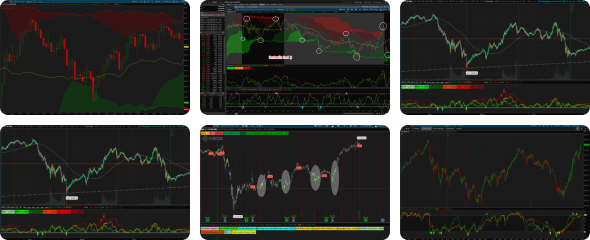

Adaptive Momentum Structure with Dynamic Fibonacci Zones
Author: CANDO13579
Concept Overview
The Multi-RSI Fibonacci Channel is a volatility-adaptive momentum framework that:
• Computes multiple advanced RSI variants (RSI, RSX, Ehlers, Harris, Slow, etc.)
• Smooths price with selectable MA types
• Builds a dynamic high-low channel on RSI
• Projects Fibonacci retracement levels inside the RSI range
• Highlights momentum expansion, compression, and reversal zones
It transforms RSI from a static oscillator into a structure-based momentum map.
Core Components
RSI Engine (Selectable)
Adaptive RSI Channel
The channel is calculated from:
• Highest RSI over N bars
• Lowest RSI over N bars
• Dynamic range = High − Low
This creates a living RSI box that expands in trend and contracts in consolidation.
Fibonacci Momentum Zones
Inside the RSI range:
support & resistance inside momentum itself.
Color Logic
• RSI turns Lime → New momentum high
• RSI turns Pink → New momentum low
• Channel turns Green → Expansion
• Channel turns Brown → Compression
• Fib 50% = Balance line
• Fib 61.8% = Institutional reload zone
Multi-Timeframe Behavior
1–5 Minute (Scalping)
• Trade from Fib 61.8 → Fib 23.6 in trend
• Fade at 76.4 when RSI color flips
• Use 50% as VWAP-like equilibrium
Signal Logic
• Bull: RSI rejects 61.8 and turns Lime
• Bear: RSI rejects 38.2 and turns Pink
15–30 Minute (Day Trading)
• Trend continuation above Fib 38.2
• Mean reversion between 50 and 61.8
• Distribution when RSI stalls at channel top and color flips
1H–4H (Swing Trading)
• Accumulation = RSI compressing between 38.2–61.8
• Breakout = Channel expansion + RSI Lime at 61.8
• Trend failure = RSI falls below 38.2 and channel slopes down
Daily / Weekly (Position Trading)
• Long bias above Fib 50
• Institutional accumulation = RSI holds 61.8
• Macro tops = RSI fails at channel high with bearish color shift
Trend Continuation
Unlike standard RSI:
• It is context-aware (dynamic range)
• It uses institutional smoothing (RSX / Ehlers)
• It maps market structure onto momentum
• It provides objective retracement zones inside RSI
• It adapts automatically to any timeframe
Author: CANDO13579
Concept Overview
The Multi-RSI Fibonacci Channel is a volatility-adaptive momentum framework that:
• Computes multiple advanced RSI variants (RSI, RSX, Ehlers, Harris, Slow, etc.)
• Smooths price with selectable MA types
• Builds a dynamic high-low channel on RSI
• Projects Fibonacci retracement levels inside the RSI range
• Highlights momentum expansion, compression, and reversal zones
It transforms RSI from a static oscillator into a structure-based momentum map.
Core Components
RSI Engine (Selectable)
| Mode | Purpose |
|---|---|
| RSI / Cutler | Classical momentum |
| Ehlers RSI | Cycle-filtered, low lag |
| Harris RSI | Volatility-weighted |
| RSX | Institutional grade smoothing |
| Slow RSI | Trend-confirmation |
| Rapid RSI | Scalping responsiveness |
Adaptive RSI Channel
The channel is calculated from:
• Highest RSI over N bars
• Lowest RSI over N bars
• Dynamic range = High − Low
This creates a living RSI box that expands in trend and contracts in consolidation.
Fibonacci Momentum Zones
Inside the RSI range:
| Level | Meaning |
|---|---|
| 23.6% | Shallow pullback |
| 38.2% | Trend continuation |
| 50% | Mean reversion pivot |
| 61.8% | Deep retracement |
| 76.4% | Exhaustion / trap zone |
Color Logic
• RSI turns Lime → New momentum high
• RSI turns Pink → New momentum low
• Channel turns Green → Expansion
• Channel turns Brown → Compression
• Fib 50% = Balance line
• Fib 61.8% = Institutional reload zone
Multi-Timeframe Behavior
1–5 Minute (Scalping)
Settings
RSI Period: 7–10
Channel Period: 20
RSI Type: RSX or Rapid
MA: EMA
Usage• Trade from Fib 61.8 → Fib 23.6 in trend
• Fade at 76.4 when RSI color flips
• Use 50% as VWAP-like equilibrium
Signal Logic
• Bull: RSI rejects 61.8 and turns Lime
• Bear: RSI rejects 38.2 and turns Pink
15–30 Minute (Day Trading)
Settings
RSI Period: 14
Channel Period: 25
RSI Type: Ehlers or RSX
MA: SMMA
Usage• Trend continuation above Fib 38.2
• Mean reversion between 50 and 61.8
• Distribution when RSI stalls at channel top and color flips
1H–4H (Swing Trading)
Settings
RSI Period: 21
Channel Period: 50
RSI Type: Slow RSI or Harris
MA: LWMA
Usage• Accumulation = RSI compressing between 38.2–61.8
• Breakout = Channel expansion + RSI Lime at 61.8
• Trend failure = RSI falls below 38.2 and channel slopes down
Daily / Weekly (Position Trading)
Settings
RSI Period: 21–34
Channel Period: 100
RSI Type: RSX
MA: EMA
Usage• Long bias above Fib 50
• Institutional accumulation = RSI holds 61.8
• Macro tops = RSI fails at channel high with bearish color shift
Trend Continuation
- RSI pulls back to 38.2
- Channel still rising
- RSI turns Lime
- Entry with stop below 50
- Target channel high
- RSI compresses near 50
- Channel range tight
- Sudden expansion
- RSI breaks 61.8 with Lime
- Ride to 76.4 and upper band
Unlike standard RSI:
• It is context-aware (dynamic range)
• It uses institutional smoothing (RSX / Ehlers)
• It maps market structure onto momentum
• It provides objective retracement zones inside RSI
• It adapts automatically to any timeframe
Code:
# Multi RSI Fibonacci Channel
# BY CANDO13579
declare lower;

input RSI_Period = 14;
input Fib_Channel_Period = 25;
input Price_Smoothing_Period = 32;
input RSI_MA_Type = {default "EMA", "SMA", "SMMA", "LWMA"};
input Price_Source = {default "Close", "Open", "High", "Low", "HL2", "HLC3", "OHLC4"};
input RSI_Type = {default "RSI", "Cutler_RSI", "Ehlers_Smoothed_RSI", "Harris_RSI", "Rapid_RSI", "RSX", "Slow_RSI"};
input Show_Fibonacci_Levels = YES;

# Price Source
def price_src;
if (Price_Source == Price_Source."Open") {
    price_src = open;
} else if (Price_Source == Price_Source."High") {
    price_src = high;
} else if (Price_Source == Price_Source."Low") {
    price_src = low;
} else if (Price_Source == Price_Source."HL2") {
    price_src = hl2;
} else if (Price_Source == Price_Source."HLC3") {
    price_src = hlc3;
} else if (Price_Source == Price_Source."OHLC4") {
    price_src = ohlc4;
} else {
    price_src = close;
}

# Moving Average
def ma_smoothed;
if (Price_Smoothing_Period <= 1) {
    ma_smoothed = price_src;
} else {
    if (RSI_MA_Type == RSI_MA_Type."SMA") {
        ma_smoothed = Average(price_src, Price_Smoothing_Period);
    } else if (RSI_MA_Type == RSI_MA_Type."SMMA") {
        # SMMA (RMA) approximation
        ma_smoothed = CompoundValue(1, (ma_smoothed[1] * (Price_Smoothing_Period - 1) + price_src) / Price_Smoothing_Period, Average(price_src, Price_Smoothing_Period));
    } else if (RSI_MA_Type == RSI_MA_Type."LWMA") {
        ma_smoothed = WMA(price_src, Price_Smoothing_Period);
    } else {
        ma_smoothed = ExpAverage(price_src, Price_Smoothing_Period);
    }
}

def smoothed_price = ma_smoothed;

# RSI Calculation (Standard RSI)
def base_rsi = RSI(price = smoothed_price, length = RSI_Period);

# Cutler RSI (same as standard RSI)
def cutler_rsi = base_rsi;

# Ehlers Smoothed RSI
def ehlers_price = (smoothed_price + 2 * smoothed_price[1] + smoothed_price[2]) / 4;
def ehlers_change = ehlers_price - ehlers_price[1];
def ehlers_up = Max(ehlers_change, 0);
def ehlers_down = -Min(ehlers_change, 0);
def ehlers_up_sum = Sum(ehlers_up, RSI_Period);
def ehlers_down_sum = Sum(ehlers_down, RSI_Period);
def ehlers_rsi_value = if (ehlers_up_sum + ehlers_down_sum == 0) then 50 else 100 * ehlers_up_sum / (ehlers_up_sum + ehlers_down_sum);
def ehlers_rsi = ehlers_rsi_value;

# Harris RSI
def harris_change = smoothed_price - smoothed_price[1];
def harris_up = Max(harris_change, 0);
def harris_down = -Min(harris_change, 0);
def harris_up_sum = Sum(harris_up, RSI_Period);
def harris_down_sum = Sum(harris_down, RSI_Period);
def harris_up_count = Sum(harris_change > 0, RSI_Period);
def harris_down_count = Sum(harris_change < 0, RSI_Period);
def harris_avg_up = if harris_up_count > 0 then harris_up_sum / harris_up_count else 0;
def harris_avg_down = if harris_down_count > 0 then harris_down_sum / harris_down_count else 0;
def harris_rsi_value = if harris_avg_down == 0 then 100 else 100 - 100 / (1 + harris_avg_up / harris_avg_down);
def harris_rsi = harris_rsi_value;

# Rapid RSI
def rapid_rsi = base_rsi;

# RSX Calculation
script RSX_Indicator {
    input src = close;
    input len = 14;

    def mom = src - src[1];
    def abs_mom = AbsValue(mom);

    # Initialize variables
    def kg = 3.0 / (2.0 + len);
    def hg = 1.0 - kg;

    # First smoothing
    def mom1;
    def mom2;
    def moa1;
    def moa2;

    if IsNaN(mom1[1]) {
        mom1 = mom;
        mom2 = mom1;
        moa1 = abs_mom;
        moa2 = moa1;
    } else {
        mom1 = kg * mom + hg * mom1[1];
        mom2 = kg * mom1 + hg * mom2[1];
        moa1 = kg * abs_mom + hg * moa1[1];
        moa2 = kg * moa1 + hg * moa2[1];
    }

    def mom_smooth1 = 1.5 * mom1 - 0.5 * mom2;
    def moa_smooth1 = 1.5 * moa1 - 0.5 * moa2;

    # Second smoothing
    def mom3;
    def mom4;
    def moa3;
    def moa4;

    if IsNaN(mom3[1]) {
        mom3 = mom_smooth1;
        mom4 = mom3;
        moa3 = moa_smooth1;
        moa4 = moa3;
    } else {
        mom3 = kg * mom_smooth1 + hg * mom3[1];
        mom4 = kg * mom3 + hg * mom4[1];
        moa3 = kg * moa_smooth1 + hg * moa3[1];
        moa4 = kg * moa3 + hg * moa4[1];
    }

    def mom_smooth2 = 1.5 * mom3 - 0.5 * mom4;
    def moa_smooth2 = 1.5 * moa3 - 0.5 * moa4;

    # Third smoothing
    def mom5;
    def mom6;
    def moa5;
    def moa6;

    if IsNaN(mom5[1]) {
        mom5 = mom_smooth2;
        mom6 = mom5;
        moa5 = moa_smooth2;
        moa6 = moa5;
    } else {
        mom5 = kg * mom_smooth2 + hg * mom5[1];
        mom6 = kg * mom5 + hg * mom6[1];
        moa5 = kg * moa_smooth2 + hg * moa5[1];
        moa6 = kg * moa5 + hg * moa6[1];
    }

    def mom_smooth3 = 1.5 * mom5 - 0.5 * mom6;
    def moa_smooth3 = 1.5 * moa5 - 0.5 * moa6;

    def rsx_value = if moa_smooth3 == 0 then 50 else ((mom_smooth3 / moa_smooth3 + 1) * 50);
    def rsx_final = if rsx_value > 100 then 100 else if rsx_value < 0 then 0 else rsx_value;

    plot result = rsx_final;
}

def rsx_rsi = RSX_Indicator(smoothed_price, RSI_Period);

# Slow RSI (smoothed standard RSI)
def slow_rsi = WildersAverage(base_rsi, RSI_Period);

# Select RSI type
def rsi_val;
if (RSI_Type == RSI_Type."Cutler_RSI") {
    rsi_val = cutler_rsi;
} else if (RSI_Type == RSI_Type."Ehlers_Smoothed_RSI") {
    rsi_val = ehlers_rsi;
} else if (RSI_Type == RSI_Type."Harris_RSI") {
    rsi_val = harris_rsi;
} else if (RSI_Type == RSI_Type."Rapid_RSI") {
    rsi_val = rapid_rsi;
} else if (RSI_Type == RSI_Type."RSX") {
    rsi_val = rsx_rsi;
} else if (RSI_Type == RSI_Type."Slow_RSI") {
    rsi_val = slow_rsi;
} else {
    rsi_val = base_rsi;
}

# Channel Calculations
def rsi_high = Highest(rsi_val, Fib_Channel_Period);
def rsi_low = Lowest(rsi_val, Fib_Channel_Period);
def rng = rsi_high - rsi_low;
def upper_band = rsi_high;
def lower_band = rsi_low;
def mid_band = (rsi_high + rsi_low) / 2;

# Fibonacci Levels
def fib236_level = rsi_low + 0.236 * rng;
def fib382_level = rsi_low + 0.382 * rng;
def fib500_level = mid_band;
def fib618_level = rsi_low + 0.618 * rng;
def fib764_level = rsi_low + 0.764 * rng;

# Color Calculations
rec upper_color_idx = if IsNaN(upper_band[1]) then 0 else
                     if upper_band > upper_band[1] then 1 else
                     if upper_band < upper_band[1] then 2 else
                     upper_color_idx[1];

rec lower_color_idx = if IsNaN(lower_band[1]) then 0 else
                     if lower_band > lower_band[1] then 1 else
                     if lower_band < lower_band[1] then 2 else
                     lower_color_idx[1];

rec rsi_color_idx = if (rsi_val == rsi_high and rsi_high != rsi_low) then 1 else
                   if (rsi_val == rsi_low and rsi_high != rsi_low) then 2 else
                   if IsNaN(rsi_color_idx[1]) then 0 else
                   rsi_color_idx[1];

# Define Colors
DefineGlobalColor("UpperLime", CreateColor(0, 255, 0));  # Lime
DefineGlobalColor("UpperBrown", CreateColor(244, 164, 96));  # Sandy Brown
DefineGlobalColor("RSIPink", CreateColor(255, 138, 197));  # Pink
DefineGlobalColor("FillGreen", CreateColor(221, 247, 221));  # Light Green
DefineGlobalColor("FillOrange", CreateColor(253, 238, 227));  # Light Orange

# Plot RSI Line
plot RSI_Line = rsi_val;
RSI_Line.AssignValueColor(
    if rsi_color_idx == 1 then GlobalColor("UpperLime")
    else if rsi_color_idx == 2 then GlobalColor("RSIPink")
    else Color.GRAY
);
RSI_Line.SetLineWeight(2);
RSI_Line.SetDefaultColor(Color.GRAY);

# Plot Channel Bands
plot UpperBand = upper_band;
UpperBand.AssignValueColor(
    if upper_color_idx == 1 then GlobalColor("UpperLime")
    else if upper_color_idx == 2 then GlobalColor("UpperBrown")
    else Color.GRAY
);
UpperBand.SetLineWeight(1);
UpperBand.SetStyle(Curve.FIRM);

plot LowerBand = lower_band;
LowerBand.AssignValueColor(
    if lower_color_idx == 1 then GlobalColor("UpperLime")
    else if lower_color_idx == 2 then GlobalColor("UpperBrown")
    else Color.GRAY
);
LowerBand.SetLineWeight(1);
LowerBand.SetStyle(Curve.FIRM);

# Plot Mid Band (hidden, used for fill)
plot MidBand = mid_band;
MidBand.SetDefaultColor(Color.CURRENT);
MidBand.Hide();

# Fibonacci Levels (optional)
plot Fib236Line = if Show_Fibonacci_Levels then fib236_level else Double.NaN;
Fib236Line.SetDefaultColor(Color.GRAY);
Fib236Line.SetStyle(Curve.FIRM);  # Changed to solid line

plot Fib382Line = if Show_Fibonacci_Levels then fib382_level else Double.NaN;
Fib382Line.SetDefaultColor(Color.GRAY);
Fib382Line.SetStyle(Curve.FIRM);  # Changed to solid line

plot Fib500Line = if Show_Fibonacci_Levels then fib500_level else Double.NaN;
Fib500Line.SetDefaultColor(Color.GREEN);  # Changed to green
Fib500Line.SetStyle(Curve.FIRM);  # Changed to solid line

plot Fib618Line = if Show_Fibonacci_Levels then fib618_level else Double.NaN;
Fib618Line.SetDefaultColor(CreateColor(255, 165, 0));  # Changed to orange
Fib618Line.SetStyle(Curve.FIRM);  # Changed to solid line

plot Fib764Line = if Show_Fibonacci_Levels then fib764_level else Double.NaN;
Fib764Line.SetDefaultColor(Color.GRAY);
Fib764Line.SetStyle(Curve.FIRM);  # Changed to solid line

# Add fills
#AddCloud(UpperBand, MidBand, GlobalColor("FillGreen"), GlobalColor("FillGreen"));
#AddCloud(MidBand, LowerBand, GlobalColor("FillOrange"), GlobalColor("FillOrange"));


# Overbought/Oversold lines
plot OverboughtLine = 70;
OverboughtLine.SetDefaultColor(Color.GRAY);
OverboughtLine.SetStyle(Curve.SHORT_DASH);

plot OversoldLine = 30;
OversoldLine.SetDefaultColor(Color.GRAY);
OversoldLine.SetStyle(Curve.SHORT_DASH);
Last edited by a moderator: