
jngy2k
Member
mod note:
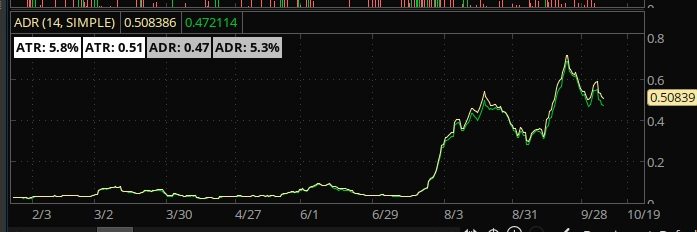
This script is basically a volatility dashboard.
It tells you one thing:
ATR
--How much the ticker typically moves per bar, including gaps.
What to do with it:
ADR
--Is this thing even worth trading right now?
What to do with it:
ATR% and ADR% tell you How wild is this thing compared to its price?
Before entering a trade
When setting stops. Place stops outside ATR noise. If ATR is 0.40, a 0.10 stop is suicide.
When setting targets. Use ADR as the ceiling for the day. If ADR is 1.50 and the ticker already moved 1.20, don’t expect another 1.00 leg.
When choosing what to trade.
ATR tells you how volatile the ticker normally is; ADR tells you how much of today’s move is already used up. Together they tell you whether the trade has room, whether your stop is safe, and whether the ticker is even worth touching.
I couldn't find one in this forum that was simple and showed percentages of the price. Plots both ADR and ATR with their percentages as labels.
Let me know if it can be improved.
This script is basically a volatility dashboard.
It tells you one thing:
How much room does this ticker realistically have to move today?
ATR
--How much the ticker typically moves per bar, including gaps.
What to do with it:
Position sizing: Higher ATR → smaller size.
Stop placement: Your stop must be outside the ATR noise.
Expectations: If ATR is 0.50, don’t expect a $2 move.
Avoid chop: Low ATR = dead ticker = skip it.
ATR tells you, Is this thing even worth trading right now?ADR
--Is this thing even worth trading right now?
What to do with it:
Profit targets: ADR gives you the realistic max move for the day.
Don’t chase late: If ADR is already 80–100% used up, the move is likely done.
Avoid over‑expectation: If ADR is 1.20, don’t expect a 4‑point runner.
ADR tells you “How much juice is left in today’s move?”ATR% and ADR% tell you How wild is this thing compared to its price?
Before entering a trade
Check ADR% used →
If the ticker already used 70–100% of ADR, don’t expect a big continuation.
Check ATR% →
If ATR% is high, tight stops will get shredded.
When setting stops. Place stops outside ATR noise. If ATR is 0.40, a 0.10 stop is suicide.
When setting targets. Use ADR as the ceiling for the day. If ADR is 1.50 and the ticker already moved 1.20, don’t expect another 1.00 leg.
When choosing what to trade.
Low ATR/ADR = dead ticker → skip it.
High ATR/ADR = opportunity → trade it, but size down.
ATR tells you how volatile the ticker normally is; ADR tells you how much of today’s move is already used up. Together they tell you whether the trade has room, whether your stop is safe, and whether the ticker is even worth touching.
I couldn't find one in this forum that was simple and showed percentages of the price. Plots both ADR and ATR with their percentages as labels.
Let me know if it can be improved.
Code:
declare lower;

input length = 14;

plot ATR = MovingAverage(AverageType.wilders, TrueRange(high, close, low), length);
ATR.SetDefaultColor(GetColor(8));

AddLabel (yes, "ATR:" + Round((ATR / close) * 100, 3) + "%", Color.WHITE);


AddLabel (yes, "ATR:" + round((ATR) , 3), Color.white);


plot ADR = MovingAverage(AverageType.wilders, high-low, length);
ADR.SetDefaultColor(GetColor(6));

AddLabel (yes, "ADR:" + round((ADR) , 3), Color.light_green);

AddLabel (yes, "ADR:" + Round((ADR / close) * 100, 3) + "%", Color.light_green);
Last edited by a moderator: