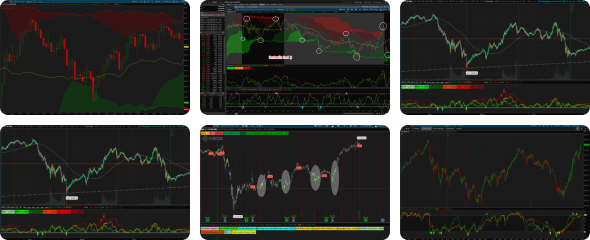
Follow The Money — Complete Cockpit Command Center
This is a new chart setup and Cockpit Command Center. In this chart setup you don’t have to hunt through clutter! Your eyes need to land on the chart and immediately know:
· Where am I — Murrey Math
· Which way — cloud and ribbon
· Is there fuel — lower panel
· Is there conviction — VOL label
· What do I do — the primary label lights up
The Cockpit Command Center Dual Chart Link: http://tos.mx/!zo51Og80
The Cockpit Command Center Chart Look:
Master Narrative
(This chart is the difference between a Cockpit and a Christmas Tree. Many traders build Christmas Trees and wonder why they’re confused. One just does not need all the lights and ornaments?)
The Philosophy
The entire system is built around one principle — follow the institutional money. Every component answers a specific question a pilot needs answered before making a decision. You don't guess, you don't hope — you read the instruments and act on confluence. We always require a minimum of two independent indicators in agreement before placing any trade. The more layers that align the higher the conviction and the larger the position size warranted.
The Instrument Stack
Layer 1 — Upper (Options Command Center v3.0) The primary cockpit. Labels, arrows, cloud, VWAP, and EMA ribbon. All non-repainting. This is the decision engine.
Layer 2 — Lower (Follow The Money) The engine room. Real time institutional money flow analytics. The fuel gauge for every trade decision.
Layer 3 — ATR 1.75 Bubble Indicator The first altitude warning. White bubbles firing when price reaches 1.75 times the average true range from the prior close. This indicator repaints — use it as a heads up warning, not a hard signal. When the bubble fires the move has reached a statistically significant distance and a pause or reversal is increasingly likely.
Layer 4 — ATR 2.0 Squared Histogram The altitude alarm. Green or red squared bars firing when price reaches 2.0 times the average true range. This indicator repaints — use it as an exit warning, not a hard signal. When the histogram fires the move is fully extended and the risk/reward has shifted dramatically against holding.
Layer 5 — Murrey Math Pivot Points The structural map. Eight horizontal levels defining where price wants to go, where it will pause, and where it will reverse. Non-repainting, purely mathematical, and respected by institutional traders worldwide. These are your targets, your stops, and your context for every trade.
Layer 6 — Scanner The radar. Runs the identical confluence logic across your entire watchlist simultaneously on the 5 minute chart. Finds the planes worth flying and hands them to the cockpit for execution.
The Murrey Math Framework
Before reading any other instrument understand where price is within its Murrey Math structure. The eight levels from bottom to top:
- 0/8 — Major support, oversold extreme. Puts at risk, calls favored on bounce
- 1/8 — Weak support, price rarely stays here long
- 2/8 — Strong support, second only to 4/8. Call entries favored here
- 3/8 — Lower range of consolidation. Below here bearish, above here neutral
- 4/8 — The most powerful level. Major support AND resistance. Price gravitates here. VWAP often aligns here intraday
- 5/8 — Upper range of consolidation. Above here bullish, below here neutral
- 6/8 — Strong resistance, mirror of 2/8. Put entries favored here
- 7/8 — Weak resistance, price rarely stays here long
- 8/8 — Major resistance, overbought extreme. Calls at risk, puts favored on rejection
- Between 3/8 and 5/8 — consolidation zone, reduced conviction, smaller size or no trade
- Above 5/8 — bullish territory, calls favored
- Below 3/8 — bearish territory, puts favored
- At 2/8 or 6/8 — high probability reversal zones, watch for full confluence
Pre-Flight Check — Before the Market Opens
Load your scanner on the daily chart before the bell. You are looking for names where price is already positioned on the right side of VWAP with the EMA ribbon stacked and Murrey Math levels above as clear targets. These are your candidates for the day. Note where the key MM levels sit on each candidate — you want to know before the trade where your first target is and where your stop makes sense structurally.
Reading the Full Stack in Sequence
Step 1 — Murrey Math Context Before anything else establish where price is within the MM framework. Is price above or below 4/8? Is it approaching a key level or sitting in the middle of a range? Price approaching 2/8 from above with bearish signals is a high probability put setup. Price bouncing off 2/8 with bullish signals is a high probability call setup. Never enter a trade without knowing where the nearest MM levels are.
Step 2 — Lower Panel First Glance at the lower panel histogram. Green bars growing and signal line rising means institutional money is actively flowing in. Red bars growing means it is flowing out. Large directional bars mean conviction. Choppy small bars mean no conviction — stay on the ground. This is the fuel gauge. No fuel, no flight.
Step 3 — Upper Cockpit Alignment Read the labels left to right across the bottom:
- OPTIONS: LONG CALL ▲ or OPTIONS: LONG PUT ▼ — the primary directive
- TREND: LONG ▲ or SHORT ▼ — EMA ribbon stacked and aligned
- VWAP: LONG SIDE ▲ or SHORT SIDE ▼ — right side of institutional fair value
- MFI: CALL FAVORED or PUT FAVORED — momentum building in the right direction
- FLOW: BUY CALLS ▲ or BUY PUTS ▼ — net money flow histogram confirming
- VOL: INSTITUTIONAL — big money behind the move
Step 4 — Cloud Transition The EMA cloud between the 9 and 21 EMA is your trend transition visual. Dark green cloud means the fast EMA is above the slow EMA — bullish transition confirmed. Dark red cloud means the fast is below the slow — bearish transition confirmed. A cloud color change is your visual cue that the trend is shifting. The cloud is non-repainting and confirms what the labels are telling you.
Step 5 — Entry Arrow The large green or red arrow fires when all five confluence conditions align simultaneously — accumulation or distribution bar, MFI direction, histogram direction, VWAP position, and EMA ribbon all agree. This is your entry signal. Before acting on the arrow confirm that Murrey Math structure supports the trade direction and that at least one additional indicator agrees.
The Entry Sequence — Complete
When the cockpit is fully aligned this is the complete picture you want to see before entering:
Call Entry — All Layers Aligned:
- Murrey Math — price above 4/8 or bouncing off 2/8 support
- Lower histogram — large green bars, signal line rising
- VWAP label — LONG SIDE ▲
- Trend label — LONG ▲
- MFI label — CALL FAVORED or rising through 50
- Flow label — BUY CALLS ▲
- VOL label — INSTITUTIONAL
- Cloud — dark green
- Arrow — large green arrow fires
- ★ BUY CALL NOW ★ label lights up
- Next MM level above — identified as your first target
Minimum requirement — two layers in agreement. Full conviction — all layers aligned.
Managing the Trade — The Complete Exit Framework
Once you are in the trade all six layers work together to manage the position:
Murrey Math Targets The MM levels above current price on a call trade are your structured profit targets. The sequence:
- First MM level above entry — first profit target, consider taking 25-33% off
- Second MM level above — second target, take another 25-33% off
- Third MM level or 8/8 — full exit consideration regardless of other signals
- Take partial profit — 25 to 50% of position
- Move stop to breakeven on remainder
- Watch the lower histogram — if bars start shrinking the fuel is fading
- Cross reference with nearest MM level — if price is also at a MM resistance level the exit is more urgent
- Consider closing the full remaining position
- Theta decay is accelerating against your premium
- Mean reversion from 2.0 ATR can be violent and fast
- If price is simultaneously at a MM level — exit immediately, no debate
- At CAUTION + MM resistance + 1.75 ATR — take significant profit
- At CAUTION + MM resistance + 2.0 ATR — close everything
- First entry is already profitable
- Lower histogram bars still growing
- Have not yet hit 1.75 ATR bubble
- Price has not yet reached next MM resistance level
- Primary label still shows LONG CALL or LONG PUT
The Complete Exit Decision Tree
•In a call trade — Lower histogram bars shrinking = Fuel fading — tighten stop
•⚠ CAUTION fires = Engine temp red — consider partial exit
•1.75 ATR bubble fires (confirmed at bar close) = first altitude warning — take partial profit move stop to breakeven
•Price reaches MM resistance level = Structural target hit — take profit per plan
•2.0 ATR histogram fires (confirmed at bar close) = Altitude alarm — close full position
•Any TWO of the above simultaneously = Exit immediately — no debate
When the Layers Conflict
•Upper says LONG CALL but lower histogram is shrinking The confluence fired but the fuel is already fading. Late entry — pass and wait for the next setup.
•Arrow fires but price is between MM levels with no clear target The signal is valid but the trade has no defined target. Wait for price to pull back to a MM support level for a cleaner entry with defined reward.
•Arrow fires but price is directly at a MM resistance level The signal is valid but the reward is immediately capped. The next MM level is your only target and it may be too close for meaningful options profit. Pass or wait for the breakout above resistance.
•In a call trade and 1.75 ATR bubble fires Not a contradiction — the system doing its job. Take partial profit, tighten the stop. Check the nearest MM level. If price is also at MM resistance — the exit is urgent.
•MFI says EXTENDED but price is still moving The most dangerous condition in options trading. Premium is at peak, move is at peak, and you are at a point where one headline reverses everything. If price is simultaneously approaching a MM level — that is the exit, not a holding point.
•Cloud turns red while holding calls The fast EMA has crossed below the slow EMA. The trend transition is starting. This is not yet a hard exit but it is a serious warning. Tighten stops aggressively and do not add to the position.
•Scanner fires but MM structure is in a consolidation zone The confluence is real but the structural context is choppy. Reduce size significantly or wait for price to exit the consolidation zone before entering.
The Complete Six Layer Decision Loop
Scanner fires on symbol
↓
Check Murrey Math — where is price structurally?
↓
Is there a clear target above (calls) or below (puts)?
↓
Lower histogram — large directional bars, signal line moving
↓
Upper labels — all six aligned with primary directive
↓
Cloud — correct color for trade direction
↓
Entry arrow fires at or near MM support/resistance
↓
Minimum two layers in agreement — execute the option
↓
First MM level hit — first partial profit
↓
1.75 ATR bubble fires — second partial profit
↓
move stop to breakeven
↓
Second MM level or 2.0 ATR histogram — close remainder
↓
⚠ CAUTION at any MM level — exit everything
↓
Reset — identify next MM level, wait for next setup
Trade Sizing by Confluence
Not all setups are equal. Size your position accordingly:
Layers Aligned | Conviction | Suggested Size |
| 2 layers | Minimum | 25% of max size |
| 3 layers | Moderate | 50% of max size |
| 4 layers | Good | 75% of max size |
| 5 layers | High | Full size |
| All 6 layers | Maximum | Full size, scale in on confirmation |
Final Thought
What you have built is not just an indicator stack — it is a complete institutional grade options trading system. Six layers, each doing a specific job, each confirming or warning, each adding to the conviction of the trade or telling you to stand aside.
The lower tells you where the money is flowing. The upper tells you what to do about it. The ATR bubbles and histogram tell you when the move is getting old — and note they repaint so always confirm at bar close. Murrey Math tells you where price wants to go and where it will respect structure. The scanner finds the opportunities across your entire watchlist. And the golden rule holds above all else — never trade on one indicator alone.
Scanner — finds the plane
Murrey Math — reads the map
Lower panel — checks the fuel
Upper cockpit — clears for takeoff
ATR warnings — calls altitude
Cloud and arrows — confirms the runway
Two in agreement — minimum to fly
All six aligned — full throttle
Trust the instruments. Manage the trade. Follow the money.

ADDING THE SCANNER:
HOW TO LOAD THE SCANNER
- Go to Scan tab → Stock Hacker
- Add a Study Filter → select FollowTheMoney_Scanner
- Set the plot to is true
- Set Scan In to your watchlist
- Set aggregation to 5 min
- Hit Scan
Code:
#================================================

# FOLLOW THE MONEY — OPTIONS SCANNER
# Scans watchlist for full confluence
# call and put setups on 5 min chart
# Author: AGAIG Custom Study
# Version: 1.0

#================================================

# Signal Settings
input MFI_Length = 14;
input Volume_Multiplier = 1.5;
input Vol_Avg_Length = 20;
input Signal_Length = 9;
input OB_Level = 80;
input OS_Level = 20;
input Price_Close_Pct = 0.6;

# EMA

input EMA_Fast = 9;
input EMA_Slow = 21;
input EMA_Trend = 50;

# Scan Toggle

input Scan_Calls = yes;
input Scan_Puts = yes;
#------------------------------------------------
# PRICE & VOLUME
#------------------------------------------------

def h = high(period = AggregationPeriod.FIVE_MIN);
def l = low(period = AggregationPeriod.FIVE_MIN);
def c = close(period = AggregationPeriod.FIVE_MIN);
def v = volume(period = AggregationPeriod.FIVE_MIN);
def hl = h - l;
#------------------------------------------------
# VWAP
#------------------------------------------------
def vwap = VWAP(period = AggregationPeriod.FIVE_MIN);
def aboveVWAP = c > vwap;
#------------------------------------------------
# EMA RIBBON
#------------------------------------------------
def emaFast = ExpAverage(c, EMA_Fast);
def emaSlow = ExpAverage(c, EMA_Slow);
def emaTrend = ExpAverage(c, EMA_Trend);

def emaRibbonBull = emaFast > emaSlow and emaSlow > emaTrend;
def emaRibbonBear = emaFast < emaSlow and emaSlow < emaTrend;
#------------------------------------------------
# VOLUME & MONEY FLOW
#------------------------------------------------
def avgVol = Average(v, Vol_Avg_Length);
def isHighVol = v >= avgVol * Volume_Multiplier;
def typicalPrice = (h + l + c) / 3;
def rawMoneyFlow = typicalPrice * v;
def posFlow = if typicalPrice > typicalPrice[1] then rawMoneyFlow else 0;
def negFlow = if typicalPrice < typicalPrice[1] then rawMoneyFlow else 0;
def sumPos = Sum(posFlow, MFI_Length);
def sumNeg = Sum(negFlow, MFI_Length);

def moneyRatio = if sumNeg == 0 then 100 else sumPos / sumNeg;
def MFI = 100 - (100 / (1 + moneyRatio));

def netFlow = sumPos - sumNeg;
def netFlowN = netFlow / avgVol;
def signalLine = ExpAverage(netFlowN, Signal_Length);
def histogram = netFlowN - signalLine;
#------------------------------------------------
# INSTITUTIONAL BAR DETECTION
#------------------------------------------------
def barRange = if hl > 0 then hl else 0.0001;
def closePct = (c - l) / barRange;
def accumulation = isHighVol and closePct >= Price_Close_Pct;
def distribution = isHighVol and closePct <= (1 - Price_Close_Pct);
#------------------------------------------------
# CONFLUENCE CONDITIONS
#------------------------------------------------
def mfiAbove50 = MFI > 50;
def histPositive = histogram > 0;
def callSignal = accumulation
and mfiAbove50
and histPositive
and aboveVWAP
and emaRibbonBull;

def mfiBelow50 = MFI < 50;
def histNegative = histogram < 0;

def putSignal = distribution
and mfiBelow50
and histNegative
and !aboveVWAP
and emaRibbonBear;
#------------------------------------------------
# SCAN RESULT
#------------------------------------------------
plot Scan = (Scan_Calls and callSignal)
or (Scan_Puts and putSignal);

#End Code
HAPPY TRADING!
Last edited by a moderator: