
clatham
New member
Hi, as a long-time lurker, I wanted to finally contribute by sharing the chart setup and strategy that have proven most effective for me. My goal is to give back to the community while detailing the most important insights I've gathered on my journey toward consistent profitability. Before diving into the strategy and charts of my approach, I want to extend a sincere thank you to the moderators and the regular contributors on this forum. Your collective education and discussions over the past five years have been invaluable. This is the only forum I visit regularly, and the quality of the people here is truly exceptional. To everyone who has shared charts, answered questions, or offered feedback, thank you for the immense value you've provided to me and many others.
My chart was born by assembling a handful of my favorite indicators that I sourced from this forum. Most of them I’ve had AI update to my liking so that they fit within my trading style. I’ve also adopted layman terms for the technical aspect of these indicators so if any confusion, please ask me to clarify.
Shared Chart Link: https://tos.mx/!6XGNjIG2
The core of my trading approach is to:
Below are the main indicators I rely on and how I utilize each in my strategy.
I only trade tick charts and this strategy has been built strictly around them, so I cannot speak to how my chart and indicators will behave on a time-based chart.
I have three tick charts up at all times, all three have the same indicators (I do change the colors on the swingarm indicator though)
ATR Swingarm (adopted and modified from this thread) - Used to determine directional bias, identify pullback entry areas, and define risk.
Candle Colors (adopted and modified from this thread) - Used to provide an easy read on momentum without taking up chart space.
Lower Study (consolidated from several indicators; WaveTrend, Mobius' TMO, MarketMemory) - Used to help determine when price is extended/exhausted.
Opening Range (OR), VWAP, Measured Moves (MM) (found here) - Used to see intraday levels that price can, and likely will, react to.
EMA cloud (found here) - Used to help me join a trend, add to an existing trade, take profit, or exit a trade.
Trade example (NOTE - this is a hand-picked trade, not all of them are this pretty or easy to manage. But I wanted to demonstrate how I use my indicators and strategy on a clean example. Having said that, these types of trades happen frequently, sometimes multiple times per day. Always use your stop loss and let your indicators & market structure guide your trade management.)
For shorts, the logic is the same just in reverse. Remember that price often behaves more erratically and moves faster on downward moves.
It took me the better half of a decade to become a consistently profitable trader. I now make a better living doing this than my corporate job would ever allow me to. If there’s only two things that I wish I could have learned sooner (and many dollars ago), it’d be:
I hope someone finds some use in this strategy and chart. Please let me know if any questions about anything, I'm happy to answer. I'm also open to critiques and welcome feedback.
Again, a million thanks to everyone here that has unknowingly helped me become a better trader.
Best of luck out there.
My chart was born by assembling a handful of my favorite indicators that I sourced from this forum. Most of them I’ve had AI update to my liking so that they fit within my trading style. I’ve also adopted layman terms for the technical aspect of these indicators so if any confusion, please ask me to clarify.
Shared Chart Link: https://tos.mx/!6XGNjIG2
The core of my trading approach is to:
- Identify a value area after a market structure shift.
- Wait for a pullback.
- Initiate a directionally aligned trade while maintaining strictly defined (and as minimal as possible) risk.
Below are the main indicators I rely on and how I utilize each in my strategy.
I only trade tick charts and this strategy has been built strictly around them, so I cannot speak to how my chart and indicators will behave on a time-based chart.
I have three tick charts up at all times, all three have the same indicators (I do change the colors on the swingarm indicator though)
- Main chart = 1600 ticks
- Precise entry/exit chart = 800 ticks
- Higher for bias & S/R levels = 3200 ticks
ATR Swingarm (adopted and modified from this thread) - Used to determine directional bias, identify pullback entry areas, and define risk.
- When price surpasses the final fib level, the swingarm flips to bearish/bullish, this determines my trade direction.
- The new fib cloud that appears is my preferred entry zone.
- The newly formed fib 3 line is my stop loss area.
- Note - the deeper that price pulls back into the clouds, surpassing the ATR fib levels, the lower the risk; but that also increases risk the trade will not work out. However, with such minimal defined risk, sometimes it’s worth buying very close to that final fib 3 level, especially if price begins to push back up.
Candle Colors (adopted and modified from this thread) - Used to provide an easy read on momentum without taking up chart space.
- The candles are painted using the colors from the histogram contained in the B4 study, I believe this is based on Bollinger band momentum pressure instead of EMA momentum spread, like MACD.
- I enjoy the visual appeal of seeing momentum shifting on the candles themselves during a trade. It can serve as a heads up when entering/exiting.
- Bright green = Bullish momentum strong/expanding
- Dark green = Bullish momentum weakening
- Bright red = Bearish momentum strong/expanding
- Dark red = Bearish momentum weakening
Lower Study (consolidated from several indicators; WaveTrend, Mobius' TMO, MarketMemory) - Used to help determine when price is extended/exhausted.
- I use this mainly to see two things:
- A cross of the zero line can mean that price confirming a change in direction, I watch for a cross above/below the zero-line after a deep pullback (or multiple candle prints within a cloud) and an exit out of the fib clouds, to enter a trade.
- To show that price is overextended and to exit a trade. Or, if you’re feeling frisky, take a counter-trend trade back to the EMA/fib cloud when trend structure breaks. Note - The green/red arrows on the top chart come from this indicator when the WaveTrend portion hits extreme oversold/overbought areas.
Opening Range (OR), VWAP, Measured Moves (MM) (found here) - Used to see intraday levels that price can, and likely will, react to.
- OR lines: Expect support/resistance here if price revisits them later in the day. Also use with MM for trading breakouts.
- Measured Move lines are derived from the opening range range. Consider these lines to be your first/second target for opening range breakouts. There’s a 3rd set within the study, I just keep those off bc they’re rarely hit and it keeps 2 lines off my chart.
- If opening range is 40 points, the first MM level is ½ that, so 20 points away from the OR line.
- The second MM level is 100% of OR distance, or 40 points away from OR line.
- VWAP (I like to think of it as the fair value price) provides context to who is “in control” for the day. Acts like a magnet, especially on slow/choppy days. Can be used to determine if a pullback within a fib cloud is at or near a fair value or not. If trading near VWAP, expect a more controlled and persistent fight between buyers/sellers. Trends near VWAP are usually shorter lived because neither buyers nor sellers disagree on price much. As price moves away from VWAP, expect more volatile trends to develop as contracts are aggressively auctioned off; emotions begin taking over, and doubt begins to set in on whether the price they’ve paid for their contracts was a fair value or not.
- Price stays above/below VWAP = trend day
- Price above/below VWAP = choppy day, don’t have a long hold conviction
- VWAP deviation bands I’ve also found are decent support/resistance areas especially later in the day.
- Triple Exhaustion Arrows - Used to give a heads up when price is exhausted within a trend.
- I use these to give me an alert when price may be getting oversold/overbought. If I am up decently in a trade, I will likely start planning to exit, especially if paired with a green/red WaveTrend arrow and dark green candle colors. That is almost always an immediate take profit indicator.
- Conversely, you could also plan to reverse your trade into a counter-trend trade back to the EMA or fib clouds.
EMA cloud (found here) - Used to help me join a trend, add to an existing trade, take profit, or exit a trade.
- If I do not get my ideal entry of opening a trade in a pullback to the fib cloud, I will sometimes enter a position when price pulls back to the EMA cloud. My stop would be the low of the lowest candle within the cloud or if price was struggling to exit the EMA cloud, whichever is first.
- If I am currently in a trade and price closes above/below the EMA cloud against the trend (or prints several candles within the cloud), I will likely exit the trade as it shows trend momentum has weakened, trade confidence decreases the longer price stays within the EMA cloud.
- On strong moves when the lower indicator has not crossed the zero-line in a pullback to the EMA cloud, I will use this as a place to add more contracts to my trade, I usually wait to see the candle colors begin shifting to indicate weakening in the pullback momentum before I add more. Ex - trend is bearish, price pushes up to EMA cloud, lower indicator not above zero line, candles turn from dark red > bright green > dark green > bright red. I’ll add more contracts when the dark green or bright red candles begin to appear again and price exits the cloud.
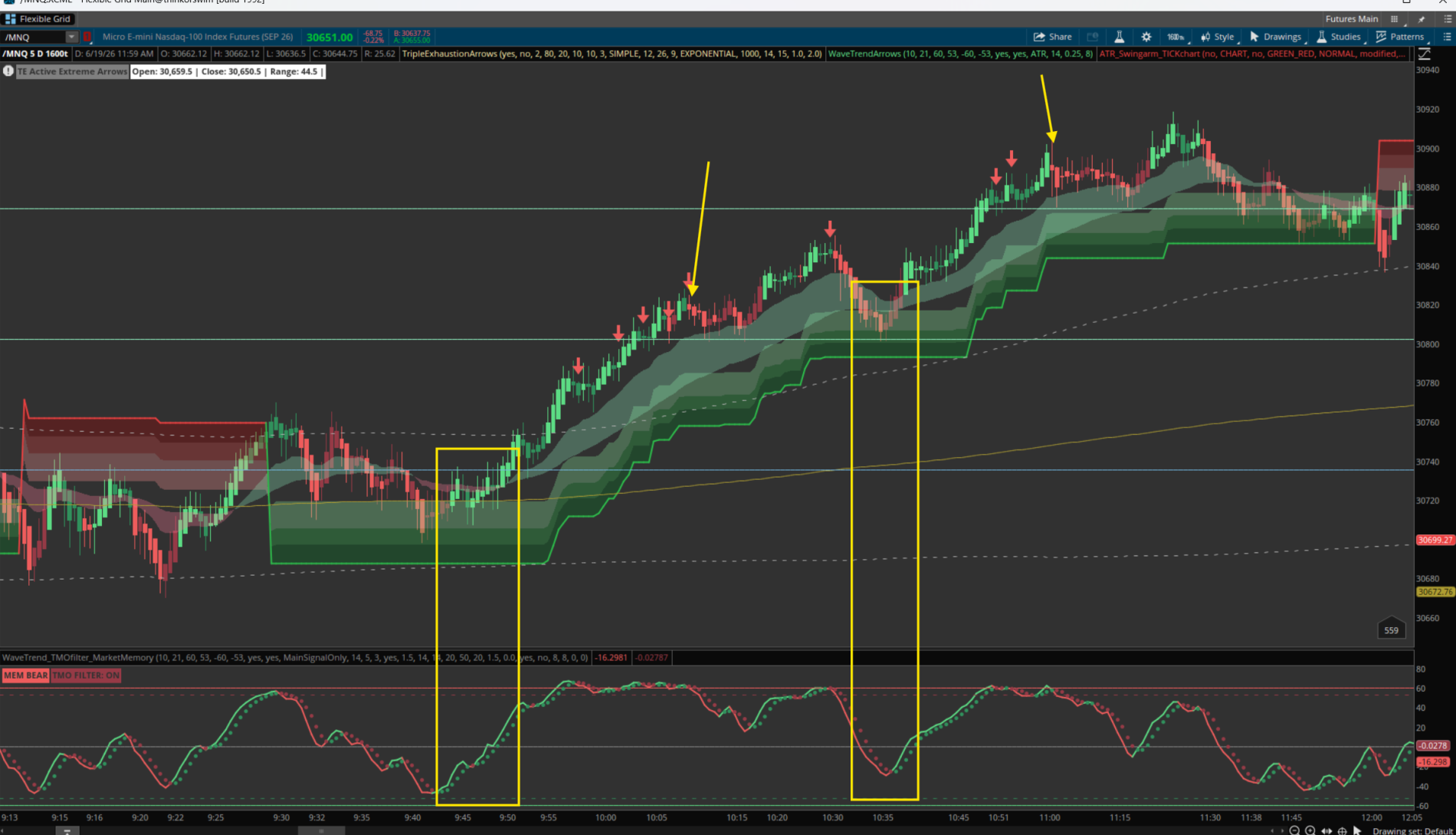
Trade example (NOTE - this is a hand-picked trade, not all of them are this pretty or easy to manage. But I wanted to demonstrate how I use my indicators and strategy on a clean example. Having said that, these types of trades happen frequently, sometimes multiple times per day. Always use your stop loss and let your indicators & market structure guide your trade management.)
- Price broke above the OR (blue line) and flipped the swingarm bullish.
- I now have a bullish trade direction bias, I’m simply waiting for price to give me an entry opportunity so I can mitigate risk and not chase. (It’s very rare that I enter a trade outside of a pullback to a fib cloud.)
- A side note on entering trades - I’ve found that the best trades are usually when price enters the fib cloud and then quickly rejects out, preferably with a long wick. This shows that there’s people out there thinking just like you are, ready to buy (or sell) around the price you also want to buy (or sell) at.
- Price pulls back into the swingarm fib cloud. However, momentum has turned bearish as indicated by the candle colors.
- Note - a low risk entry would have been the lowest red candle dipping into the middle green cloud. You’d have about 15-20 points of defined risk; if price had continued downward and flipped the swingarm back to bearish, you’d exit with a small loss.
- A more confident entry comes when the candles turn bullish and the lower indicator crosses the zero line and the blue OR line.
- Note - remember that MM lines (the two green lines) are your OR breakout targets. That is about 80 NQ points to the upside from the OR blue line. Let’s do some quick math, assuming you took the trade at the highest green fib cloud, your risk:reward ratio is a little greater than 1:2 on this trade since you know the bottom swingarm green line is your absolute stop level. If you had taken the red candle entry at the second fib cloud line, your R:R is about 1:5.5
- Now that we’ve entered, we simply ride the EMA cloud up to our target. (See how I utilize the EMA cloud in trade management above)
- We see that overbought arrows appear. That’s OK, there’s no reason to panic and exit early as price never even touched the EMA cloud. In fact, we never even got a bearish-colored momentum candle.
- In this example specifically, I would have exited on the first red candle when those arrows began printing. If you would have exited there, you’d be up either 80-95 points depending on which entry you chose.
- If you weren’t off celebrating your win, you’d notice another trade sets up immediately after that last one. It looks like the trend is adhering to a healthy market structure. And remember, the MM lines are your price targets after an ORB.
- We have a beautiful pullback to the green fib cloud. The EMA cloud never turned against us. Candle colors turn dark red indicating bearish momentum is waning. The lower study crosses back over the zero line and candles turn green. It’s giving you every possible green light to go long again.
- If you entered, the candles guide you up to the 100% OR line where price blows through it.
- You then get another set of exhaustion arrows and finally a red candle telling you to take your money and go home.
- Rinse and repeat long and short all throughout the day (or night, if that’s your jam).
For shorts, the logic is the same just in reverse. Remember that price often behaves more erratically and moves faster on downward moves.
It took me the better half of a decade to become a consistently profitable trader. I now make a better living doing this than my corporate job would ever allow me to. If there’s only two things that I wish I could have learned sooner (and many dollars ago), it’d be:
- Risk management is the single most important factor for anyone that wants to trade for a living.
- Always enter a trade with pre-defined risk. That is why I enjoy this strategy so much. If price crosses the third and final fib level, I exit the trade, no questions asked or thinking about it. I simply close the trade and wait for another setup to appear. No one bats 1000 in this game, losing trades is part of it, but those that manage their risk the best survive and thrive; the best loser wins.
- Nobody knows what the market will do next.
- Futures are extremely risky financial instruments. Volatile news events cannot be predicted or avoided. You absolutely must have a stop loss set. I always enter trades with a trigger entry that sets my stop loss and take profit level when I’m filled. I adjust these when I get into a trade but I never increase my stop, unless it’s moving up to breakeven or further (if I have to step away). If trading NQ, moves can be 200+ points in seconds. A stop loss is non-negotiable.
I hope someone finds some use in this strategy and chart. Please let me know if any questions about anything, I'm happy to answer. I'm also open to critiques and welcome feedback.
Again, a million thanks to everyone here that has unknowingly helped me become a better trader.
Best of luck out there.
Last edited: