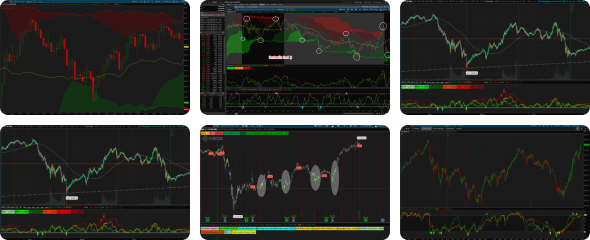

I also like Dans2_RedKChopBreakout. This has kept me clear of sideways traps when playing momentum trades. https://tos.mx/!AM4v2s7t

Code:
#// © RedKTrader
#// plots a centered oscillator based on how many ATR units the source price is from a price baseline (could be a Donchian midline or another slow MA)
#// the Chop Zone is detected when the price is within a customizable ATR-based distance above or below the baseline
#// a filter is then applied (using EMA - but can be other types of long-term MA) to indicate the preferred trade direction (long vs. short)
#// when the CBS line is inside the chop zone, trading is not recommended for the conservative trader
#// Breakouts are found when the CBS line exits the Chop zone (in agreement with the filter direction)
#// An aggressive swing trader can consider positions when the CBS line crosses the 0 line in the filter direction
#indicator('RedK Chop & Breakout Scout ', shorttitle='C&B_Scout v2.0'
#https://www.tradingview.com/script/jnWK8gZg-RedK-Chop-Breakout-Scout-C-B-Scout/
# Converted and mod by Sam4Cok@Samer800 - 08/2022

#//                                  ATR Calclatioin Function
#// ==============================================================================================
script nz {
    input data = 0;
    input replacement  = 0;
    def ret_val = if IsNaN(data) then replacement else data;
    plot return = ret_val;
}
# RMA(src, length)=>
script RMA {
    input src = close;
    input length = 14;
    def   alpha = 1 / length;
    def sum;
    sum = if IsNaN(sum[1]) then SimpleMovingAvg(src, length) else alpha * src + (1 - alpha) * nz(sum[1]);
    plot  Return = sum;
}
#ATR_Calc(_price, _length, _atrcalc) =>
script ATR_Calc {
    input _price = close;
    input _length = 0;
    input _atrcalc = "RMA";
    def ATR_Calc = if _atrcalc == "RMA" then RMA(_price, _length) else
                   if _atrcalc == "SMA" then SimpleMovingAvg(_price, _length) else
                   if _atrcalc == "EMA" then ExpAverage(_price, _length) else
                    WMA(_price, _length);
    plot return = ATR_Calc;
}
#=================================================================================================
#                                 Inputs
#=================================================================================================

input Src         = close;    # Price
input BaselineLength = 10;    # Baseline Length
input AtrLength   = 10;       # ATR Avg Length
input MAType      = {default "RMA", "SMA", "EMA", "WMA"}; # MA Calculation
input ChopLevel   = 0.5;      # Chop Level
input smooth      = 3;        # Smooth
input EMAFilter   = 20;       # EMA Filter
input ShowAlert   = yes;

#=================================================================================================
#                                  Calculations
#=================================================================================================
declare lower;
def na = Double.NaN;

#//calculate baseline price - added other slow MA's
def baseline    = (Highest(high, BaselineLength) + Lowest(low, BaselineLength)) / 2;

#// Calculate ATR
def tr = if IsNaN(close[1]) then high - low else
                Max(Max(high - low, AbsValue(high - close[1])), AbsValue(low - close[1]));

def ATR = ATR_Calc(tr, BaselineLength, MAType);

#// CBS value is basically how far is current price from the baseline in terms of "ATR units"
def cbs    = (Src - baseline) / ATR;
def scbs1  =  WMA(cbs, smooth);
def scbs   =  WMA(scbs1, smooth);
#// check where is price wrt the filter line to determine recommended trading direction
#// in v1, we use an EMA-based filter as it's most popular -- may add other MA types in future.
def f_modelong1  = Src > ExpAverage(Src, EMAFilter);
def f_modelong = f_modelong1;

# =================================================================================================
#                                  Plots
# =================================================================================================

plot zeroLine = 0;        # Zero Line
zeroLine.SetPaintingStrategy(PaintingStrategy.DASHES);
zeroLine.SetDefaultColor(Color.GRAY);
def h0          = ChopLevel;     # "Chop Zone - Upper"
def h1          = -ChopLevel;    # "Chop Zone - Lower"

AddChart(high = if f_modelong then h0 else na,
         low = if f_modelong then h1 else na,
         open =  if f_modelong then h0 else na,
         close = if f_modelong then h1 else na,
         type = ChartType.CANDLE, growcolor = CreateColor(0,100,0));
AddChart(high = if !f_modelong then h0 else na,
         low = if !f_modelong then h1 else na,
         open = if !f_modelong then h0 else na,
         close = if !f_modelong then h1 else na,
         type = ChartType.CANDLE, growcolor =CreateColor(100,0,0));

plot CBSSmooth = scbs;    # "CBS Smooth"
CBSSmooth.AssignValueColor(if f_modelong and cbs > ChopLevel then CreateColor(41,98,255) else
          if !f_modelong and cbs < -ChopLevel then CreateColor(242,54,69) else Color.WHITE);
CBSSmooth.SetLineWeight(3);
#====================================================================================
#                                  Alerts
#====================================================================================
plot up = if ShowAlert and f_modelong and (cbs crosses above ChopLevel) and scbs > scbs[1] then ChopLevel else na;
plot dn = if ShowAlert and !f_modelong and (cbs crosses below -ChopLevel) and scbs < scbs[1] then -ChopLevel else na;
up.SetPaintingStrategy(PaintingStrategy.SQUARES);
up.SetDefaultColor(Color.GREEN);
up.SetLineWeight(2);
dn.SetPaintingStrategy(PaintingStrategy.SQUARES);
dn.SetDefaultColor(Color.RED);
dn.SetLineWeight(2);

### END
Last edited by a moderator: