
Reverse Engineered RSI — Translating Momentum Into Price
Most traders use RSI as a traditional oscillator:
It tells you where momentum is — not where price must go for momentum to change.
A Reverse Engineered RSI solves that problem.
Instead of plotting RSI values in a lower panel, the indicator mathematically projects the exact price levels required for RSI to reach key thresholds such as:
What the Indicator Actually Does
The script reconstructs the internal RSI smoothing components:
So rather than asking:
…it asks:
Why This Matters
Traditional RSI is reactive.
Reverse Engineered RSI is predictive.
Instead of waiting for RSI to print:
This creates several advantages:
1. Forward-Looking Momentum Levels
You can see where momentum conditions will trigger before price reaches them.
2. Dynamic Support & Resistance
The projected RSI levels often behave like adaptive support/resistance zones.
3. Trend Continuation Context
In strong trends:
When price extends too far beyond projected RSI equilibrium levels, reversal probability increases.
5. Better Risk Management
The projected levels can help define:
Interpreting the Lines
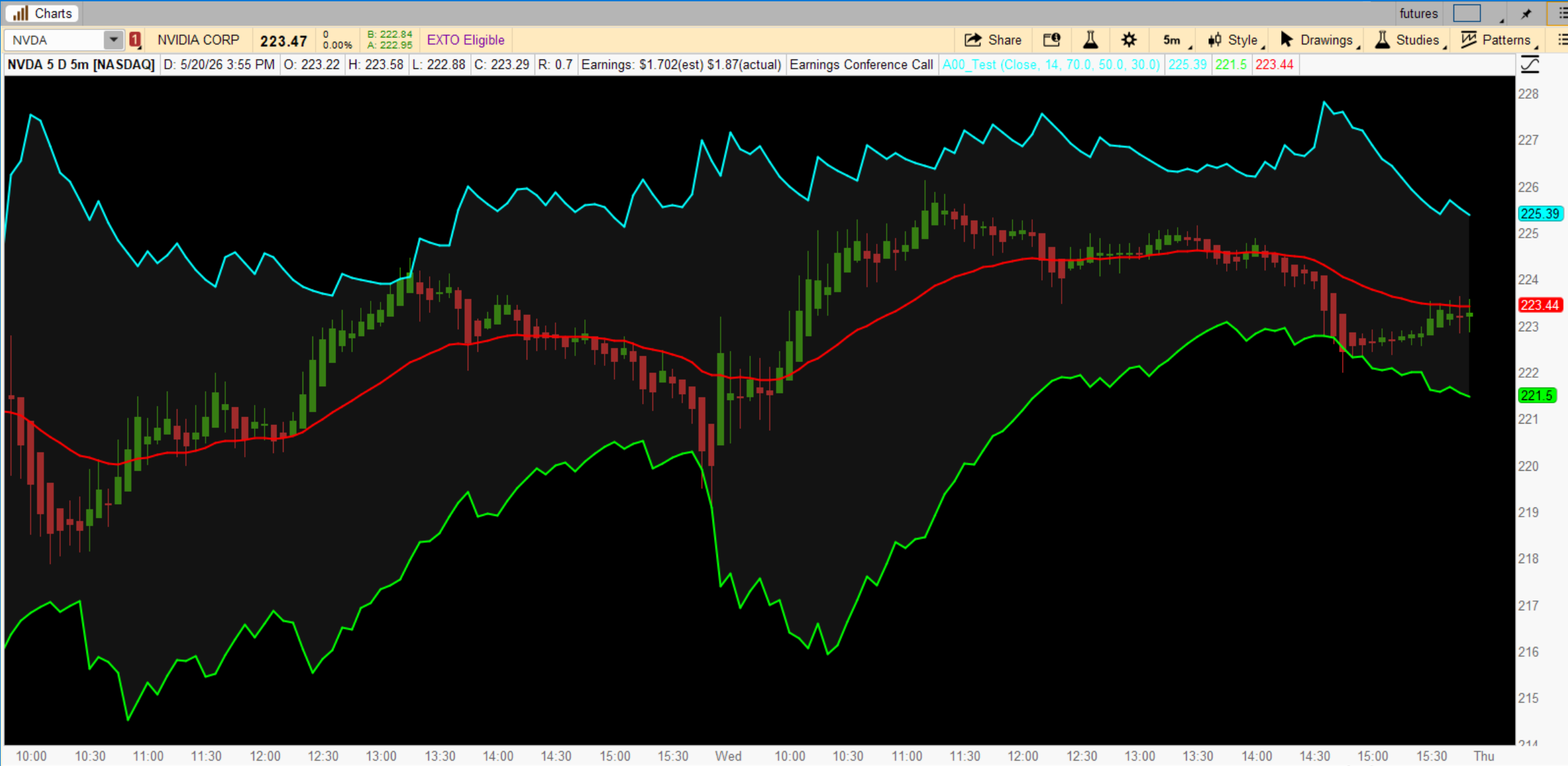
Top Line (RSI Overbought Projection)
This is the projected price level where RSI would equal 70.
If price reaches this line:
This is the projected price level where RSI would equal 30.
If price reaches this line:
This is one of the most important levels.
RSI 50 is often considered the equilibrium line between bullish and bearish momentum.
The projected RSI-50 price frequently acts as:
Professional traders care less about oscillator readings alone and more about:
Key Concept
A normal RSI says:
A Reverse Engineered RSI says:
That difference changes RSI from a reactive oscillator into a predictive price-mapping tool.
A traditional oscillator has a structural problem:
Strong trends create persistent momentum.
That means:
The Reverse Engineered RSI helps because it changes how you interpret those conditions.
The Important Shift
Traditional RSI focuses on:
Why This Helps
Instead of treating RSI 70 as an automatic reversal signal, the reverse-engineered approach lets you observe:
Is price ACCEPTING above the projected RSI-70 level?
or
Is price REJECTING it?
That difference tells you whether momentum is:
Example
Suppose:
But reverse-engineered RSI asks:
If price:
This Is Extremely Important
In strong trends:
What You Begin To See
Weak Trend Behavior
Price touches projected RSI-70 level and immediately rejects:
Price repeatedly holds above RSI-70 projected level:
Why RSI-50 Projection Is Often More Important
Professional traders frequently care more about:
What Reverse RSI Really Solves
It does NOT magically predict reversals.
What it improves is CONTEXT.
It helps answer:
The best traders do not use RSI levels as automatic reversal signals.
They use them as:
That makes the indicator significantly more aligned with:
You begin thinking:
That is a much more advanced way to read trend strength.
Most traders use RSI as a traditional oscillator:
- Above 70 = overbought
- Below 30 = oversold
- Around 50 = directional bias
It tells you where momentum is — not where price must go for momentum to change.
A Reverse Engineered RSI solves that problem.
Instead of plotting RSI values in a lower panel, the indicator mathematically projects the exact price levels required for RSI to reach key thresholds such as:
- RSI 70
- RSI 50
- RSI 30
What the Indicator Actually Does
The script reconstructs the internal RSI smoothing components:
- Average Upward Change (AUC)
- Average Downward Change (ADC)
So rather than asking:
“What is RSI right now?”
…it asks:
The result is a dynamic framework of projected momentum-based support and resistance.“At what price would RSI become overbought, oversold, or neutral?”
Why This Matters
Traditional RSI is reactive.
Reverse Engineered RSI is predictive.
Instead of waiting for RSI to print:
- 70
- 50
- 30
This creates several advantages:
1. Forward-Looking Momentum Levels
You can see where momentum conditions will trigger before price reaches them.
2. Dynamic Support & Resistance
The projected RSI levels often behave like adaptive support/resistance zones.
3. Trend Continuation Context
In strong trends:
- price may ride the RSI 50 projection
- RSI 70 projections can act as continuation expansion zones
When price extends too far beyond projected RSI equilibrium levels, reversal probability increases.
5. Better Risk Management
The projected levels can help define:
- invalidation zones
- momentum breakout thresholds
- exhaustion targets
Interpreting the Lines
Top Line (RSI Overbought Projection)
This is the projected price level where RSI would equal 70.
If price reaches this line:
- momentum is entering an overextended state
- continuation or exhaustion behavior can be monitored
This is the projected price level where RSI would equal 30.
If price reaches this line:
- downside momentum is becoming stretched
- reversal or stabilization zones may emerge
This is one of the most important levels.
RSI 50 is often considered the equilibrium line between bullish and bearish momentum.
The projected RSI-50 price frequently acts as:
- trend bias confirmation
- dynamic pullback support
- directional control level
Code:
# ============================================
# Price Plotting Reverse RSI----CANDO13579
# ============================================

declare upper;

# -----------------------------
# Inputs
# -----------------------------
input priceType = {default Close, Open, High, Low, Median, Typical, Weighted};
input period = 14;
input ob = 70.0;
input cl = 50.0;
input os = 30.0;

# -----------------------------
# Applied Price
# -----------------------------
def src =
    if priceType == priceType.Close then close
    else if priceType == priceType.Open then open
    else if priceType == priceType.High then high
    else if priceType == priceType.Low then low
    else if priceType == priceType.Median then (high + low) / 2
    else if priceType == priceType.Typical then (high + low + close) / 3
    else (open + high + low + close) / 4;

# -----------------------------
# Wilder-style smoothing
# Matches Pine logic
# -----------------------------
def expPeriod = 2.0 * period - 1.0;
def k = 2.0 / (expPeriod + 1.0);

# -----------------------------
# Recursive AUC / ADC
# -----------------------------
rec auc =
    if BarNumber() == 1 then 0
    else if src > src[1] then
        k * (src - src[1]) + (1 - k) * auc[1]
    else
        (1 - k) * auc[1];

rec adc =
    if BarNumber() == 1 then 0
    else if src > src[1] then
        (1 - k) * adc[1]
    else
        k * (src[1] - src) + (1 - k) * adc[1];

# -----------------------------
# Reverse Levels
# -----------------------------
def x1 = (period - 1) * (adc * ob / (100 - ob) - auc);

def top =
    if x1 >= 0 then
        src + x1
    else
        src + x1 * (100 - ob) / ob;

def x2 = (period - 1) * (adc * os / (100 - os) - auc);

def bottom =
    if x2 >= 0 then
        src + x2
    else
        src + x2 * (100 - os) / os;

def x3 = (period - 1) * (adc * cl / (100 - cl) - auc);

def central =
    if x3 >= 0 then
        src + x3
    else
        src + x3 * (100 - cl) / cl;

# -----------------------------
# Plots
# -----------------------------
plot TopLine = top;
TopLine.SetDefaultColor(Color.CYAN);
TopLine.SetLineWeight(2);

plot BottomLine = bottom;
BottomLine.SetDefaultColor(Color.GREEN);
BottomLine.SetLineWeight(2);

plot CentralLine = central;
CentralLine.SetDefaultColor(Color.RED);
CentralLine.SetLineWeight(2);

# Optional cloud
AddCloud(TopLine, BottomLine, Color.DARK_GRAY, Color.DARK_GRAY);
Professional traders care less about oscillator readings alone and more about:
- where liquidity may react
- where momentum conditions shift
- where trend structure changes
- oscillator mathematics
- real executable price levels
- discretionary trading
- intraday execution
- trend continuation models
- systematic frameworks
Key Concept
A normal RSI says:
“Momentum became overbought.”
A Reverse Engineered RSI says:
“This is the exact price where momentum will become overbought.”
That difference changes RSI from a reactive oscillator into a predictive price-mapping tool.
A traditional oscillator has a structural problem:
RSI can remain overbought or oversold far longer than traders expect.
Strong trends create persistent momentum.
That means:
- RSI can stay above 70 for days
- RSI can stay below 30 during prolonged selloffs
The Reverse Engineered RSI helps because it changes how you interpret those conditions.
The Important Shift
Traditional RSI focuses on:
- the oscillator reading itself
- the price structure required to maintain that momentum
Why This Helps
Instead of treating RSI 70 as an automatic reversal signal, the reverse-engineered approach lets you observe:
Is price ACCEPTING above the projected RSI-70 level?
or
Is price REJECTING it?
That difference tells you whether momentum is:
- expanding
- stabilizing
- exhausting
Example
Suppose:
- projected RSI-70 price = 525
- current price = 527
“RSI is overbought.”
But reverse-engineered RSI asks:
“Can price sustain acceptance above the RSI-70 equilibrium?”
If price:
- consolidates above it
- bases above it
- trends along it
- strong directional control
- trend continuation
- momentum persistence
This Is Extremely Important
In strong trends:
- overbought conditions are often bullish
- oversold conditions are often bearish
- exhaustion
vs - trend acceptance
What You Begin To See
Weak Trend Behavior
Price touches projected RSI-70 level and immediately rejects:
- failed expansion
- momentum exhaustion
- possible mean reversion
Price repeatedly holds above RSI-70 projected level:
- persistent institutional pressure
- trend continuation
- momentum acceptance
Why RSI-50 Projection Is Often More Important
Professional traders frequently care more about:
- whether momentum stays structurally bullish
than - whether momentum briefly becomes overbought
- pullbacks often stabilize near projected RSI-50 price
- continuation begins from there
- dynamic trend support
- momentum equilibrium
- pullback continuation zone
What Reverse RSI Really Solves
It does NOT magically predict reversals.
What it improves is CONTEXT.
It helps answer:
- Is momentum accelerating?
- Is momentum being accepted?
- Is price structurally maintaining strong RSI conditions?
- Is the market rejecting momentum extremes?
- Is trend structure weakening?
“RSI crossed 70.”
The best traders do not use RSI levels as automatic reversal signals.
They use them as:
- momentum state references
- trend persistence measurements
- expansion/compression markers
- exhaustion context
That makes the indicator significantly more aligned with:
- market structure
- trend behavior
- liquidity movement
- institutional momentum dynamics
“RSI is overbought.”
You begin thinking:
“Price is sustaining momentum above the overbought equilibrium.”
That is a much more advanced way to read trend strength.
Last edited by a moderator: