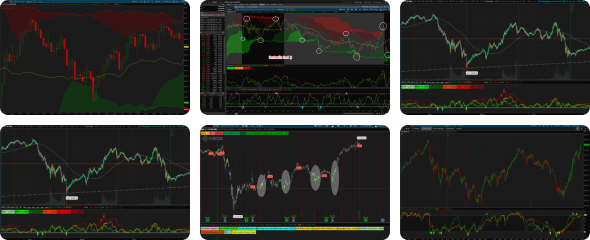
# Price Memory Trend – LOWER Oscillator
# Assembled by Chewie 2/4/2026
# Lower companion to PMT Bands

declare lower;

# =========================
# INPUTS
# =========================
input memoryStrength = 0.12;
input memoryDecay    = 0.96;
input devLen         = 50;
input bandMult       = 1.6;

input atrLength      = 50;
input atrMult        = 1.3;


# =========================
# COLORS
# =========================
DefineGlobalColor("Bull", CreateColor(0, 255, 170));
DefineGlobalColor("Bear", CreateColor(255, 0, 255));
DefineGlobalColor("Neutral", Color.GRAY);

# =========================
# PRICE MEMORY ENGINE
# =========================
def price = close;

rec memory =
    if BarNumber() == 1 then price
    else memory[1] + (price - memory[1]) * memoryStrength;

def base = memory * memoryDecay + price * (1 - memoryDecay);

# =========================
# ADAPTIVE DEVIATION
# =========================
def dev    = AbsValue(price - base);
def avgDev = ExpAverage(dev, devLen);

def rawUpper = base + avgDev * bandMult;
def rawLower = base - avgDev * bandMult;

# =========================
# TREND STATE
# =========================
def bullCond1 = price crosses above rawUpper;
def bearCond1 = price crosses below rawLower;

rec trendState =
    if BarNumber() == 1 then 0
    else if bullCond1 then 1
    else if bearCond1 then -1
    else trendState[1];

# =========================
# TRAILING CORE
# =========================
rec trailLower =
    if BarNumber() == 1 then rawLower
    else if trendState == 1 then Max(rawLower, trailLower[1])
    else rawLower;

rec trailUpper =
    if BarNumber() == 1 then rawUpper
    else if trendState == -1 then Min(rawUpper, trailUpper[1])
    else rawUpper;

def core =
    if trendState == 1 then trailLower
    else if trendState == -1 then trailUpper
    else base;

# =========================
# NORMALIZED OSCILLATOR
# =========================
def atr = Average(TrueRange(high, close, low), atrLength);

# Distance from PMT core, normalized by ATR
def osc =
    if atr != 0 then
        (price - core) / (atr * atrMult)
    else 0;

# =========================
# PLOTS
# =========================
plot PMT = osc;
PMT.AssignValueColor(
    if trendState == 1 then GlobalColor("Bull")
    else if trendState == -1 then GlobalColor("Bear")
    else GlobalColor("Neutral")
);
PMT.SetLineWeight(3);

plot ZeroLine = 0;
plot one = 1.0;
plot none = -1.0;
plot two = 2.0;
plot ntwo = -2.0;
plot three = 3.0;
plot nthree = -3.0;
ZeroLine.SetDefaultColor(Color.yellow);
one.SetDefaultColor(Color.dark_red);
none.SetDefaultColor(Color.dark_green);
two.SetDefaultColor(Color.red);
ntwo.SetDefaultColor(Color.green);
three.SetDefaultColor(Color.magenta);
nthree.SetDefaultColor(Color.cyan);


# =========================
# BULL / BEAR ZONES
# =========================
AddCloud(PMT, ZeroLine,
         GlobalColor("Bull"), Color.CURRENT);

AddCloud(ZeroLine, PMT,
         GlobalColor("Bear"), Color.CURRENT);

AddCloud(2, 3,  color.current, GlobalColor("Bear"));
AddCloud(-3, -2, color.current, GlobalColor("Bull"));

def bullcore1 = if trendState == 1 then -2 else double.nan;
def bullouter1 = if trendState == 1 then -3 else double.nan;
def bearcore1 = if trendState == -1 then 2 else double.nan;
def bearouter1 = if trendState == -1 then 3 else double.nan;

AddCloud(bullCore1, bullouter1,
         color.green, GlobalColor("Bull"));

AddCloud(bearCore1, bearouter1,
         GlobalColor("Bear"), color.red);


# DIVERGENCE

input divergenceLength = 20; #hint divergenceLength: The number of bars used to calculate divergences.

input divergenceType = {default regular, reverse}; #hint divergenceType: The type of divergence. A regular divergence is when price is making higher highs (or lower lows), while the indicator is making lower highs (or higher lows). A reverse divergence (also called a hidden divergence) is when the indicator is making higher highs (or lower lows), while price is making lower highs (or higher lows).
#Hint: The output of this indicator is for informational and educational use only, is not an investment recommendation or advice, and should not be relied upon in making the decision to buy or sell a security or pursue a particular investment strategy.

def xDownBars;
def xUpBars;
def xDowns;
def xUps;
def hiBars;
def loBars;
def pivotTop;
def pivotBottom;
def hiInd;
def loInd;
def hiPrice;
def loPrice;
plot bearishd;
plot bullishd;

def K = PMT;
def Over_Boughta = 1.5;
def Over_Solda = -1.5;


def ind;
ind = k;

# Bearish
pivotTop =
if
    divergenceType == divergenceType.regular
then
    ind[1] > over_Boughta and ind[1] == Highest(ind, divergenceLength + 1)
else
    ind[1] >= 50 and
    ind[1] == highest(ind, divergenceLength + 1) and
    ind[1] == highest(ind, divergenceLength+1)[-divergenceLength+1];

if pivotTop
then {
    hiBars = 1;
    hiInd = ind[1];
    hiPrice = max(high[2], max(high[1], high[0]));
}
else {
    hiBars = hiBars[1] + 1;
    hiInd = hiInd[1];
    hiPrice = hiPrice[1];
}

if ind[1] crosses below  Over_Boughta
then {
    xDownBars = 1;
    xDowns = xDowns[1] + 1;
}
else {
    xDownBars = xDownBars[1] + 1;
    xDowns = if pivotTop[1] then 0 else xDowns[1];
}

def bearCond;
switch (divergenceType) {
case regular:
bearCond =
    ind[1] >= ZeroLine and
    ind < ind[1] and
    high[1] == Highest(high, divergenceLength + 1) and
    hiBars[1] > xDownBars[1] and
    xDowns == 1 and
    close < close[1] and
    hiPrice[1] < high[1] and
    hiInd[1] > ind[1];
case reverse:
bearCond =
    ind[1] >= ZeroLine and
    ind < ind[1] and
#    high[1] == Highest(high, divergenceLength) and
#    hiBars[1] > xDownBars[1] and
#    xDowns == 1 and
    close < close[1] and
    hiPrice[1] > high[1] and hiPrice[1] > high and
    hiInd[1] < ind[1];}

bearishd =
    if
        bearCond
    then
        ind[1]
    else
        Double.NaN;;

bearishd.SetPaintingStrategy(PaintingStrategy.ARROW_DOWN);
bearishd.SetDefaultColor(Color.CYAN);
bearishd.setLineWeight(2);
bearishd.hideTitle();
bearishd.hideBubble();

def countBear = if bearCond[-1] then countBear[1] + 1 else countBear[1];
def recentBear = countBear == HighestAll(countBear);
def secHigh = highestAll(if bearCond[-1] and recentBear then ind else Double.NaN);
#def firstHigh = highestAll(if bearCond and recentBear and ind[1] == secHigh then hiInd[1] else double.NaN);
def FH_bar = highestAll(if recentBear and bearCond[-1] and ind == secHigh then getvalue(barNumber(), hibars) else double.NaN);

plot bearTrendline =
if
    recentBear and bearCond[-1] and ind == secHigh
then
    max(ind[1], ind[0])
else
#    if pivotTop and hiInd == firstHigh
    if
        FH_bar == barNumber()
    then
        ind
    else
        double.NaN;
bearTrendline.EnableApproximation();
bearTrendline.setDefaultColor(color.RED);
bearTrendline.setLineWeight(4);
bearTrendline.hideBubble();
bearTrendline.hideTitle();

#Bullish
pivotBottom =
if
    divergenceType == divergenceType.regular
then
    ind[1] < over_Solda and ind[1] == lowest(ind, divergenceLength + 1)
else
    ind[1] <= 50 and
    ind[1] == lowest(ind, divergenceLength+1) and
    ind[1] == lowest(ind, divergenceLength+1)[-divergenceLength+1];

if pivotBottom
then {
    loBars = 1;
    loInd = ind[1];
    loPrice = min(low[2], min(low[1], low[0]));
}
else {
    loBars = loBars[1] + 1;
    loInd = loInd[1];
    loPrice = loPrice[1];
}

if ind[1] crosses above over_Solda
then {
    xUpBars = 1;
    xUps = xUps[1] + 1;
}
else {
    xUpBars = xUpBars[1] + 1;
    xUps = if pivotBottom[1] then 0 else xUps[1];
}

def bullCond;
switch (divergenceType){
case regular:
bullCond =
    ind[1] <= ZeroLine and
    ind > ind[1] and
    low[1] == Lowest(low, divergenceLength + 1) and
    loBars[1] > xUpBars[1] and
    xUps == 1 and
    close > close[1] and
    loPrice[1] > low[1] and
    loInd[1] < ind[1];
case reverse:
bullCond =
    ind[1] <= ZeroLine and
    ind > ind[1] and
#    low[1] == Lowest(low, divergenceLength) and
#    loBars[1] > xUpBars[1] and
#    xUps == 1 and
    close > close[1] and
    loPrice[1] < low[1] and loPrice[1] < low and
    loInd[1] > ind[1];}

bullishd =
    if
        bullCond
    then
        ind[1]
    else
        Double.NaN;

bullishd.SetPaintingStrategy(PaintingStrategy.ARROW_UP);
bullishd.SetDefaultColor(Color.CYAN);
bullishd.setLineWeight(2);
bullishd.HideTitle();
bullishd.HideBubble();

def countBull = if bullCond[-1] then countBull[1] + 1 else countBull[1];
def recentBull = countBull == HighestAll(countBull);
def secLow = highestAll(if bullCond[-1] and recentBull then ind else Double.NaN);
#def firstLow = highestAll(if bullCond and recentBull and ind[1] == secLow then loInd[1] else double.NaN);
def FL_bar = highestAll(if recentBull and bullCond[-1] and ind == secLow then getvalue(barNumber(), lobars) else double.NaN);

plot bullTrendline =
    if
        recentBull and bullCond[-1] and ind == secLow
    then
        min(ind[1], ind[0])
    else
        if
#            pivotBottom and loInd == firstLow
            FL_bar == barNumber()
        then
            ind[0]
        else
            double.NaN;
bullTrendline.EnableApproximation();
bullTrendline.setDefaultColor(color.GREEN);
bullTrendline.setLineWeight(4);
bullTrendline.hideBubble();
bullTrendline.hideTitle();