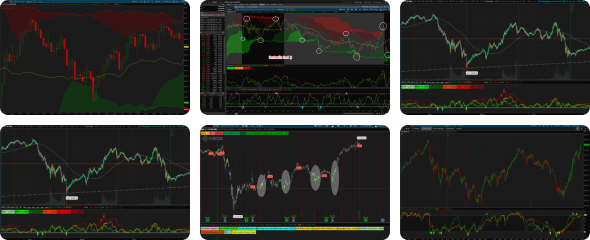

Human pattern recognition is powerful but also highly prone to false positives. In markets, this is often called "apophenia" — seeing meaningful signals in noise. Institutions know this risk and instead rely on statistically testable patterns with repeatable edge.What pattern(settings) should be used for Mega stocks? Thank you
Here are the go-to patterns and models institutional and quant traders favor, ranked by statistical robustness:
Statistically Reliable Patterns Used by Institutions
1. Mean Reversion Around VWAP / Moving Averages
- Used by: Market makers, HFTs, intraday funds
- Tools: VWAP, standard deviation bands (like Bollinger), regression channels
- Why: VWAP reflects where large volume has traded — price reversion to VWAP often happens due to institutional anchoring.
- Statistical Model: Ornstein-Uhlenbeck processes (stochastic mean-reverting)
- (e.g., RSI, Bollinger Bands, Stochastics)
- Used by: Trend followers, volatility traders
- Statistical basis:
- Low volatility regimes often precede high volatility
- Tested using ATR squeeze, Keltner vs. Bollinger bandwidth
- Quant Confirmation: Price > range high + increased volume + volatility expansion
- Popular Tools: Donchian channels, Keltner, ADX, ATR ramps
- Bollinger Band Width, ADX- Volume Spike, TTM Squeeze- Momentum, RSI, VWAP - Supply and demand zones, Price closes outside range
- Used by: Quant equity, macro funds
- Core principle: Assets that perform well continue to outperform (short-term or medium-term)
- Quant version:
- RSI > 70 + slope positive
- Price > 20d MA & 50d MA, rising
- Key Add-on: Volume confirmation or price persistence
| Signal Type | Momentum Indicator | Confirmation Pair |
|---|---|---|
| Trend + Momentum | MACD | ADX > 20 |
| Breakout Momentum | RSI > 60 | Volume Spike + OBV↑ |
| Acceleration Check | ROC | Bollinger Band Width↑ |
| Pullback Entry | Stoch RSI Cross↑ | Price > 21 EMA |
4. Divergence in Price vs. Momentum
- Used by: Discretionary institutional traders, macro traders
- Statistical type: Leading indicator of exhaustion
- Best used with:
- RSI or ROC vs price
- Volume divergence (OBV flat/down while price rises)
- Caveat: Best in combination with range-bound or mean-reverting conditions
- Recommended Setup for Divergence Detection
Combine 1 or 2 momentum indicators with simple price structure tools:- RSI + MACD Histogram
- ROC + Trendlines
- AO + Price Swings
- Stoch RSI + Support/Resistance
- Used by: High-frequency trading, execution algos
- Concept: Institutional traders watch limit order book flow → imbalance leads price
- Data Required: Level 2, DOM
- Quant Proxy: Tick imbalance, delta (buy vs. sell pressure), CVD (cumulative volume delta)
- Volume Profile indicator, Delta Volume/Bid-Ask Deltas, Cumulative Delta, VWAP & Standard Deviations and Market Structure with Volume Surge
- Used by: Options desks, gamma scalpers
- Quant tool:
- IV Rank/Percentile
- HV vs. IV comparison
- Bollinger Band width
- Why it works: Options are priced on expected volatility. When reality diverges from pricing, opportunity arises.
These aren’t shapes like “cup and handle” — they are conditions that often signal institutional behavior:
| Pattern Condition | Implication |
|---|---|
| Price flat, volume rising | Accumulation or distribution |
| Sharp drop, no volume | Lack of conviction / likely bounce |
| High OI + gamma at strike | Option dealer positioning |
| Multiple failed breakouts | Liquidity hunt / stop runs |
So what should you look for?
If you want to think like an institution, prioritize conditions, not shapes.
Instead of:
- “I think this is a head and shoulders”, Think:
- “Price is failing to make higher highs while RSI is fading and volume is declining — that’s a statistically testable reversal setup.”
Last edited by a moderator: