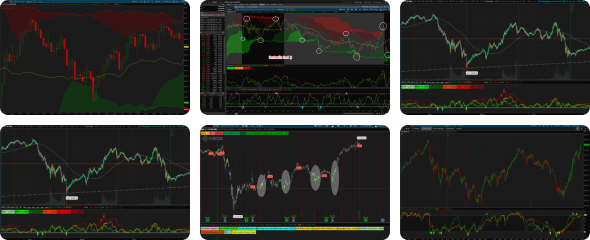
GoldenSniper Options Dashboard For ThinkOrSwim

Join useThinkScript to post your question to a community of 21,000+ developers and traders.

Would love to see how you trade this?
From the previous attached screenshot I see:
• Price ~ 6836
• Gamma flip ~ 6929
• Distortion ~ 0.83 (near normal, slightly suppressed)
• Efficiency ~ 0.00 (basically no realized expansion yet this week)
• Gamma state: negative (below flip)
• Large OI clusters: 6900, 6950 above / 6800, 6750 below

So here’s how I’d think about a 6900–6910 push idea I see from Bulls.

Structural Read
We are:
• Below gamma flip → negative gamma regime
• Distortion ~ 0.83 → options not overpriced
• Efficiency ~ 0 → move hasn’t happened yet

That combination means negative gamma + suppressed-to-normal vol + low realized movement
= stored energy. That does allow for expansion.

BUT.

Below flip = dealers will hedge in direction of move.
So IF upside gets going, it can accelerate.
If downside gets going, it can accelerate too.

This is not a fade environment.
This is a break environment.

What Needs To Happen For 6900–6910?

For a push toward 6900 We need:
• Acceptance back above 6865–6880
• Efficiency rising (price actually expanding relative to straddle)
• Distortion starting to climb toward 1.0

If distortion stays suppressed while price grinds up slowly?
That becomes dealer control grind → harder to reach flip.

If distortion rises above 1.0 while below flip?
That’s expansion in negative gamma → acceleration probability increases.

The Real Pivot Is 6929 (Flip)

6900–6910 is important because:
• It’s heavy OI
• It’s near gamma flip

But the actual structural change is not 6900.
It’s acceptance above 6929.

Below flip = breakouts extend
Above flip = moves get dampened

So if price approaches 6900–6910 next week there are two plays.

How I’d Play It
Scenario A – Early Expansion Toward 6900

Conditions:
• Distortion rising
• Efficiency rising
• Acceptance above 6880

Play:
• Long pullbacks
• Target 6900
• Trail aggressively into 6910–6930

Because near flip, behavior changes.

Scenario B – Slow Grind Toward 6900

Conditions:
• Distortion stays < 0.9
• Efficiency moderate
• No impulsive candles

Play:
• Sell put spreads below 6800
• Or sell call spreads into 6900 if rejection appears

Because suppressed vol + approaching wall = stall probability.

Scenario C – Acceptance Above 6930
If price accepts above flip, Gamma turns positive.
Then:
Execution mode becomes FADE.
You sell rips above 6950.
You buy dips back toward flip.

That’s the structural shift that @merryDay plays.

Right now the chart says:
Negative gamma + low efficiency + near-normal distortion
= energy stored.

So yes — a push toward 6900 is plausible.

But the trade is not “bet 6900”.
The trade is:
Trade expansion while below flip.
Switch to fade once above flip.

If This Were My Book- how I would play it-

Below 6850:
I would not press longs.

Above 6880 with rising distortion:
I’d lean long into 6900.

At 6900–6930:
I’d reduce size and watch for flip behavior.

Above 6930 acceptance:
I shift to fade mode.

 
Where is this study @antwerks?
I am still in the testing stages of it, but I can give you a rundown of what it is going to be doing:
VR VOL REGIME ENGINE- (How to Read It in 60 Seconds)

This tool answers one question, What kind of market are we in right now — Fade, Break, Trend, or Chop?
It uses three inputs:
  1. Distortion (premium cheap or expensive?)
  2. Efficiency (is price actually moving?)
  3. Gamma (are dealers dampening or accelerating moves?)
DISTORTION (Premium State)

Distortion = Straddle Price ÷ IV-Implied Move
ValueMeaningWhat It Tells You
< 0.80SuppressedPremium cheap, controlled market
≈ 1.00NormalFair value
> 1.20StressedPremium expensive, fear elevated

Think of this as “Are options underpriced or overpriced?”

EFFICIENCY (Is Price Delivering?)

Efficiency = Realized Move ÷ Straddle Cost
ValueMeaningWhat It Tells You
< 0.8LowGrind / pin risk
0.8–1.0ModerateBalanced
> 1.0HighExpansion / breakout

Think of this as “Is price actually moving enough to justify the premium?”

GAMMA (Structure Control)
Price vs FlipMarket Behavior
Above FlipPositive Gamma → Mean Reversion
Below FlipNegative Gamma → Expansion Risk

Think of this as “Are dealers stabilizing the move or accelerating it?”

EXECUTION MODES (What To Do)

This script combines all three and outputs:

FADE MODE - Sell edges / Buy dips / Sell rips
Occurs when:
  • Positive Gamma
  • Suppressed Distortion
  • Low Efficiency
Environment:
  • Grind
  • Range-bound
  • Pin risk
BREAK MODE - Trade acceptance / breakout
Occurs when:
  • Negative Gamma
  • Suppressed Distortion
  • Efficiency rising
Environment:
  • Expansion risk
  • Level breaks can run
TREND MODE - Ride pullbacks
Occurs when:
  • Negative Gamma
  • Stressed Distortion
  • Efficiency > 1.0
Environment:
  • Strong continuation
  • Pullbacks are entries
VOL FADE MODE- Fade volatility itself
Occurs when:
  • Distortion stressed
  • Efficiency weak
Environment:
  • Fear overpriced
  • Premium rich
Arrows

Arrows mean the environment just changed. Not “buy here.”
It means:
  • Adjust size
  • Adjust expectations
  • Reassess structure
ALIGNMENT LABEL
If you see "EXECUTION MODE AGREES WITH STRUCTURE"
That means:
  • Gamma
  • Distortion
  • Efficiency
All point the same direction. This is when size can increase.
If it says "MODE CONFLICT"
That means:
  • Mixed signals
  • Reduce size
  • Wait for clarity
How To Use It Properly
This is NOT:
  • A candle entry system
  • A timing tool
  • A signal generator
This IS:
  • A regime classifier
  • A risk allocation filter
  • A position-sizing guide
You still use for validations:
  • VWAP
  • Levels
  • Structure
  • Order flow
  • Anchored VWAP
But this tells you:
Should I be fading?
Should I be breaking?
Should I be riding?
Or should I wait?

The Entire System in Quick View

Suppressed + Positive Gamma = Fade (Volatility is cheap, price isn’t moving efficiently, and dealer hedging absorbs momentum. Action Bias: Sell rips. Buy dips. Target reversion.)
Suppressed + Negative Gamma = Break Risk (Premium is cheap, structure is unstable, and a break can run. Action Bias: Trade acceptance beyond levels. Do not fade first breaks.)
Stressed + High Efficiency + Negative Gamma = Trend (Price is delivering more than expected, and dealers must chase. Action Bias: Ride pullbacks. Avoid countertrend fades.)
Stressed + Low Efficiency = Vol Fade - (Premium is rich, but price isn’t moving enough to justify it. Action Bias: Fade volatility itself (short premium, fade extremes).)
 
@merryDay has an environmental script and you could call mine an environmental script, but they answer different questions.

merryday's Environmental Gauge is symbol-specific strength and participation.

My PRO Engine is market structure and volatility regime logic.

merryDay's is “Is this a good instrument?”
Mine is “What kind of market am I in?”

Again, they answer different questions. Both detect:
  • Expansion
  • Compression
  • Breakout quality
  • Chop
But my PRO uses volatility pricing and merryday's ENV uses price behavior.
Macro vs Micro
 
I am still in the testing stages of it, but I can give you a rundown of what it is going to be doing:
VR VOL REGIME ENGINE- (How to Read It in 60 Seconds)

This tool answers one question, What kind of market are we in right now — Fade, Break, Trend, or Chop?
It uses three inputs:
  1. Distortion (premium cheap or expensive?)
  2. Efficiency (is price actually moving?)
  3. Gamma (are dealers dampening or accelerating moves?)
DISTORTION (Premium State)

Distortion = Straddle Price ÷ IV-Implied Move
ValueMeaningWhat It Tells You
< 0.80SuppressedPremium cheap, controlled market
≈ 1.00NormalFair value
> 1.20StressedPremium expensive, fear elevated

Think of this as “Are options underpriced or overpriced?”

EFFICIENCY (Is Price Delivering?)

Efficiency = Realized Move ÷ Straddle Cost
ValueMeaningWhat It Tells You
< 0.8LowGrind / pin risk
0.8–1.0ModerateBalanced
> 1.0HighExpansion / breakout

Think of this as “Is price actually moving enough to justify the premium?”

GAMMA (Structure Control)
Price vs FlipMarket Behavior
Above FlipPositive Gamma → Mean Reversion
Below FlipNegative Gamma → Expansion Risk

Think of this as “Are dealers stabilizing the move or accelerating it?”

EXECUTION MODES (What To Do)

This script combines all three and outputs:

FADE MODE - Sell edges / Buy dips / Sell rips
Occurs when:
  • Positive Gamma
  • Suppressed Distortion
  • Low Efficiency
Environment:
  • Grind
  • Range-bound
  • Pin risk
BREAK MODE - Trade acceptance / breakout
Occurs when:
  • Negative Gamma
  • Suppressed Distortion
  • Efficiency rising
Environment:
  • Expansion risk
  • Level breaks can run
TREND MODE - Ride pullbacks
Occurs when:
  • Negative Gamma
  • Stressed Distortion
  • Efficiency > 1.0
Environment:
  • Strong continuation
  • Pullbacks are entries
VOL FADE MODE- Fade volatility itself
Occurs when:
  • Distortion stressed
  • Efficiency weak
Environment:
  • Fear overpriced
  • Premium rich
Arrows

Arrows mean the environment just changed. Not “buy here.”
It means:
  • Adjust size
  • Adjust expectations
  • Reassess structure
ALIGNMENT LABEL
If you see "EXECUTION MODE AGREES WITH STRUCTURE"
That means:
  • Gamma
  • Distortion
  • Efficiency
All point the same direction. This is when size can increase.
If it says "MODE CONFLICT"
That means:
  • Mixed signals
  • Reduce size
  • Wait for clarity
How To Use It Properly
This is NOT:
  • A candle entry system
  • A timing tool
  • A signal generator
This IS:
  • A regime classifier
  • A risk allocation filter
  • A position-sizing guide
You still use for validations:
  • VWAP
  • Levels
  • Structure
  • Order flow
  • Anchored VWAP
But this tells you:
Should I be fading?
Should I be breaking?
Should I be riding?
Or should I wait?

The Entire System in Quick View

Suppressed + Positive Gamma = Fade (Volatility is cheap, price isn’t moving efficiently, and dealer hedging absorbs momentum. Action Bias: Sell rips. Buy dips. Target reversion.)
Suppressed + Negative Gamma = Break Risk (Premium is cheap, structure is unstable, and a break can run. Action Bias: Trade acceptance beyond levels. Do not fade first breaks.)
Stressed + High Efficiency + Negative Gamma = Trend (Price is delivering more than expected, and dealers must chase. Action Bias: Ride pullbacks. Avoid countertrend fades.)
Stressed + Low Efficiency = Vol Fade - (Premium is rich, but price isn’t moving enough to justify it. Action Bias: Fade volatility itself (short premium, fade extremes).)

Excellent write up. Waiting for your study. Please keep posting updates daily if possible.
 
Ideas for Friday
TRADE IDEAS for week of February 20th
TSLA 2/20 425C | ACT AT 424, TARGET 434 STOP LOSS 400
MU 2/20 425C | ACT AT 424, TARGET 436 SL 400
SPX 2/18 6900C at 6870 | TARGETS 6900, 6921 SL 6851
SPX 2/18 6750P at 6800 | TARGETS 6765, 6720 SL 6824
 
ALSO just a tip on using RSP, If SPX is weak but RSP is holding up
That usually means:
  • the “average stock” is fine,
  • weakness is concentrated in a few heavyweight names,
  • pullbacks are more buyable (breadth isn’t breaking).
If SPX is strong but RSP lags
That usually means:
  • leadership is narrow (mega-caps doing all the work),
  • rallies are more fragile,
  • risk of a sudden air-pocket increases if leaders roll over.
My bottom line
Right now, the structure looks better in RSP than in SPX/SPY, which is a positive breadth signal, it suggests the market isn’t being held up by just a handful of big names. So when the two diverge, it’s a breadth signal: are leaders dragging the index up while most stocks lag (SPX > RSP), or are many stocks participating (RSP strong)?
As sectors rotate it's good to have this in your pocket.
 
ALSO just a tip on using RSP, If SPX is weak but RSP is holding up
That usually means:
  • the “average stock” is fine,
  • weakness is concentrated in a few heavyweight names,
  • pullbacks are more buyable (breadth isn’t breaking).
If SPX is strong but RSP lags
That usually means:
  • leadership is narrow (mega-caps doing all the work),
  • rallies are more fragile,
  • risk of a sudden air-pocket increases if leaders roll over.
My bottom line
Right now, the structure looks better in RSP than in SPX/SPY, which is a positive breadth signal, it suggests the market isn’t being held up by just a handful of big names. So when the two diverge, it’s a breadth signal: are leaders dragging the index up while most stocks lag (SPX > RSP), or are many stocks participating (RSP strong)?
As sectors rotate it's good to have this in your pocket.

I used to rely on the expected move to sell 0DTE credit spreads on SPX. Sometimes it worked, but most of the time it didn’t. Whatever I earned would get wiped out in one big move, sometimes even my capital.

SPX would often move beyond the expected range and close above or below it, wiping out all gains and capital (once in a week).

I don’t have time to monitor trades minute by minute, nor can I actively manage them. So I’m looking for lower-management trades. I may continue selling credit spreads, but I’m also open to buying debit spreads if the risk-reward setup is favorable.

I tried using GEX, but I couldn’t make it work consistently in my favor.

For now, I’ve paused trading 0DTE SPX. However, after reading your study, I’m looking forward to developing a more solid framework, one where I take a trade, set a stop loss, and review it at the end of the day. Two possible outcomes: either a loss or a win. I like that SPX is cash-settled.
 
I used to rely on the expected move to sell 0DTE credit spreads on SPX. Sometimes it worked, but most of the time it didn’t. Whatever I earned would get wiped out in one big move, sometimes even my capital.

SPX would often move beyond the expected range and close above or below it, wiping out all gains and capital (once in a week).

I don’t have time to monitor trades minute by minute, nor can I actively manage them. So I’m looking for lower-management trades. I may continue selling credit spreads, but I’m also open to buying debit spreads if the risk-reward setup is favorable.

I tried using GEX, but I couldn’t make it work consistently in my favor.

For now, I’ve paused trading 0DTE SPX. However, after reading your study, I’m looking forward to developing a more solid framework, one where I take a trade, set a stop loss, and review it at the end of the day. Two possible outcomes: either a loss or a win. I like that SPX is cash-settled.
I really appreciate you sharing that — and honestly, what you described is very common with 0DTE SPX.
Using expected move as a boundary feels logical at first. It gives structure. The problem is that expected move isn’t a ceiling or floor — it’s just a statistical estimate. On certain days, especially in negative gamma environments, price can expand well beyond that range. And when it does, it usually happens quickly.

That’s why one large move can erase weeks of steady credit spread gains. It’s not that the strategy is “wrong.” It’s that the environment matters more than the structure of the spread.

0DTE short premium works best in:
• Suppressed volatility
• Positive gamma (mean-reverting flows)
• Low expansion probability

It struggles in:
• Negative gamma
• Volatility compression breaking
• Expanding realized range


Without filtering for those conditions first, selling spreads becomes more about probability hope than structural edge. I also think your self-awareness about management style is important. 0DTE credit spreads require attention — especially on unstable days. If you don’t want to monitor minute-to-minute (which is completely reasonable), then the framework must do the filtering before entry. That’s where environment classification helps.

Instead of asking:
“Where is expected move?”
You ask:
“What type of day is this likely to be?”
• Fade day?
• Breakout risk day?
• Trend expansion day?
• Volatility stress day?


Some days the right trade is selling spreads.
Some days it’s buying defined-risk directional spreads.
Some days it’s simply no trade.


SPX being cash-settled is a huge structural advantage — but consistency comes from trading fewer days with better alignment, not trading every day with probability. Pausing was actually a smart move. It gives you space to rebuild the framework instead of forcing trades.

If your goal is:
Take the trade --- set defined risk --- review at end of day --- accept win or loss
That’s absolutely possible. It just requires tighter environmental filters before entry.

Some key takeaways: "Expected move is not a wall. It’s a probability estimate. If you sell premium without knowing when expansion probability is rising, eventually you’ll sell right before a volatility event."

"0DTE credit spreads without regime filtering is not an income strategy. It’s a volatility lottery."

If You Want Low Management, You has 3 viable paths:
Path A - Only Sell in Suppressed + Positive Gamma
Trade fewer days.
Higher consistency.

Path B - Buy Debit Spreads on Compression Break (out of a consolidation for example)
Defined risk.
Trade expansion instead of fighting it.

Path C - Move to 3–7 DTE
Less gamma shock.
More statistical edge.
Lower monitoring requirement.

And the big one!!!! "You don't have to trade today!!!! If it ain't right, hold tight!!"
 

Not the exact question you're looking for?

Start a new thread and receive assistance from our community.

87k+ Posts
2604 Online
Create Post

The Market Trading Game Changer

Join 2,500+ subscribers inside the useThinkScript VIP Membership Club
  • Exclusive indicators
  • Proven strategies & setups
  • Private Discord community
  • ‘Buy The Dip’ signal alerts
  • Exclusive members-only content
  • Add-ons and resources
  • 1 full year of unlimited support

Frequently Asked Questions

What is useThinkScript?

useThinkScript is the #1 community of stock market investors using indicators and other tools to power their trading strategies. Traders of all skill levels use our forums to learn about scripting and indicators, help each other, and discover new ways to gain an edge in the markets.

How do I get started?

We get it. Our forum can be intimidating, if not overwhelming. With thousands of topics, tens of thousands of posts, our community has created an incredibly deep knowledge base for stock traders. No one can ever exhaust every resource provided on our site.

If you are new, or just looking for guidance, here are some helpful links to get you started.

What are the benefits of VIP Membership?
VIP members get exclusive access to these proven and tested premium indicators: Buy the Dip, Advanced Market Moves 2.0, Take Profit, and Volatility Trading Range. In addition, VIP members get access to over 50 VIP-only custom indicators, add-ons, and strategies, private VIP-only forums, private Discord channel to discuss trades and strategies in real-time, customer support, trade alerts, and much more. Learn all about VIP membership here.
How can I access the premium indicators?
To access the premium indicators, which are plug and play ready, sign up for VIP membership here.
Back
Top