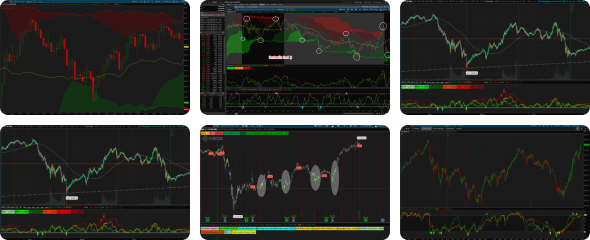
Gamma vs ORB

rene6985

New member
ORB by Toby Crabel is an old indicator, it is not worthy anymore, why, because you could see now in Gamma volume data if the market will break the opening range or not. For me it is an old stuff when data was not available before and theory was made and become a guide.
 
ORB by Toby Crabel is an old indicator, it is not worthy anymore, why, because you could see now in Gamma volume data if the market will break the opening range or not. For me it is an old stuff when data was not available before and theory was made and become a guide.

This is a common misunderstanding among newer traders.
Actually, some of the oldest strategies are still the best precisely because they measure behaviors that never disappear.

Many of the new talking‑head strategies — and the idea of relying only on Gamma volume — push traders into chasing microstructure without any macrostructure framework to anchor their decisions.

That’s backwards.
You always start with macrostructure, then refine with microstructure.
Tools like the Opening Range Breakout define the framework of the day: where the auction first balanced, where liquidity concentrated, and where the market accepted or rejected price.
Only after that structure is mapped does it make sense to layer on microstructure tools like Gamma volume, order flow, or options positioning.

ORB is not “old stuff” — it’s an essential structural map.
 
How do you use Gamma volume data?

High Gamma Volume (positive gamma environment)
Dealers hedge against price movement.​
This creates mean reversion and suppressed breakouts.​
What you see on your chart:
VWAP magnet​
Tight ranges​
Sizzle Index low​
Volume Profile balanced​

Low Gamma Volume (negative gamma environment)
Dealers hedge with price movement.​
This creates expansion, volatility, and breakout acceleration.​
What you see on your chart:
VWAP deviations hold​
Trend days​
Sizzle Index elevated​
Volume Profile thin above/below​
 
How would you structure/ combine your indicators to see all that at once? Do we have one here that would help?

Your question is essentially:
“Can I combine VWAP, trend, sizzle, and volume‑profile into one signal?”

Unfortunately, no.
There isn’t a single indicator that can compress all four of those into one clean output, because each one describes a different dimension of market behavior:
VWAP magnet → institutional fair value​
Tight ranges → volatility + compression​
Sizzle Index low → options activity + expected movement​
Balanced volume profile → auction structure + acceptance​

These aren’t ingredients for a buy/sell signal.
They’re environmental conditions, and the only way to understand them is to see how they interact together on your ORB chart.

When you view them visually, you’re answering a much bigger question:
“Is the environment supportive of a clean move, or are we stuck in balance?”

That’s the core of microstructure analysis.
It applies to any intraday strategy, with any set of indicators. You’re not looking for a single tool—you’re looking for a read on how these forces line up in real time.
 
Last edited:
Options volume shows where trades occurred.
Open interest shows where risk remains and where hedging pressure may emerge as price approaches those levels.
For your platform and GEX logic, Volume answers the question, "Did positioning change today?"
OI answers, "Where will positioning matter tomorrow?"
Options volume explains where positioning changed and why a move likely occurred.
Open interest is conditional — it becomes important only when price approaches those strikes, because that is when hedging pressure can be activated.

I tend to use both the volume and open interest, to some degree I think of them as the volume being the "past" and the Open Interest being the "future".

More times than not, Open Interest will fall in a support and resistance zones. In my opinion, you should always mark your GEX levels on your chart, especially the positive and negative transition zones!!!
 
Last edited:
Options volume shows where trades occurred.
Open interest shows where risk remains and where hedging pressure may emerge as price approaches those levels.
For your platform and GEX logic, Volume answers the question, "Did positioning change today?"
OI answers, "Where will positioning matter tomorrow?"
Options volume explains where positioning changed and why a move likely occurred.
Open interest is conditional — it becomes important only when price approaches those strikes, because that is when hedging pressure can be activated.

I tend to use both the volume and open interest, to some degree I think of them as the volume being the "past" and the Open Interest being the "future".

More times than not, Open Interest will fall in a support and resistance zones. In my opinion, you should always mark your GEX levels on your chart, especially the positive and negative transition zones!!!

Great subject, so we have gamma values study for tos, can share?
 
Last edited by a moderator:
Great subject, so we have gamma values study for tos, can share?

While there are several topics that cover Gamma Exposure (GEX), none of the indicators are overly accurate and all of them slow TOS performance substantially... I spent several months deep in the GEX rabbit hole, only to find that using values from external sites and manually updating throughout the day has performed much better... I now use a custom Study to draw my GEX levels based on data from gexstream.com as they are more dynamic than the levels that barchart.com provides...

Now, this is just my personal opinion based on ample experience with GEX... That being said, ORB requires practice and may not be suitable for all methods of trading and is best suited for intraday trading...

Do a site search for "GEX" and "Gamma Exposure" to find topics and posts on the subject...
 
Great subject, so we have gamma values study for tos, can share?
Here is something that in a way replaces having to draw your GEX data manually.
the quick description is:
# DEALER RANGES
# SETTING UP PREDICTED MOVES FOR THE WEEK
# CALL WALLS AND PUT WALLS
# WEEKLY GAMMA FLIPS FROM POSITIVE AND NEGATIVE GAMMA
# THESE PREDICTED MOVES ACT AS A FORM OF SUPPORT AND RESISTANCE
# CALL AND PUTWall WALLS ACT AS MAGNETS AND SUPPLY AND DEMANDIndex ZONES
# WEEKLY GAMMA LINE IDENTIFIES CHANGES IN DEALERS HEDGING STRATEGIES
# ANTWERKS 03/14/2026

You will find that OI sets up in these same ranges as well as most supply and demand scripts.
Code:
# DEALER RANGES
# SETTING UP PREDICTED MOVES FOR THE WEEK
# CALL WALLS AND PUT WALLS
# WEEKLY GAMMA FLIPS FROM POSITIVE AND NEGATIVE GAMMA
# THESE PREDICTED MOVES ACT AS A FORM OF SUPPORT AND RESISTANCE
# CALL AND PUTWall WALLS ACT AS MAGNETS AND SUPPLY AND DEMANDIndex ZONES
# WEEKLY GAMMA LINE IDENTIFIES CHANGES IN DEALERS HEDGING STRATEGIES
# ANTWERKS 03/14/2026


declare upper;

input showLabels = yes;

# Detect new week
def newWeek = GetWeek() <> GetWeek()[1];

# Capture Friday close
def fridayClose =
    if newWeek then close[1]
    else fridayClose[1];

# Capture IV once per week
def weeklyIV =
    if newWeek then imp_volatility()
    else weeklyIV[1];

# Weekly expected move
def EM =
    fridayClose * weeklyIV * Sqrt(7 / 365);

# Lock EM
def lockedEM =
    if newWeek then EM
    else lockedEM[1];

# Expected move levels
def EMhigh = fridayClose + lockedEM;
def EMlow  = fridayClose - lockedEM;

# Dealer levels (approx)
def callWall = fridayClose + (lockedEM * 0.75);
def putWall  = fridayClose - (lockedEM * 0.75);

# Gamma flip (pivot)
def gammaFlip = fridayClose;

# Break connection at start of week
def breakLine = if newWeek then Double.NaN else 1;

# Plots
plot ExpectedHigh = if breakLine then EMhigh else Double.NaN;
plot ExpectedLow  = if breakLine then EMlow else Double.NaN;
plot CallWall1    = if breakLine then callWall else Double.NaN;
plot PutWall1      = if breakLine then putWall else Double.NaN;
plot GammaFlip1    = if breakLine then gammaFlip else Double.NaN;

ExpectedHigh.SetPaintingStrategy(PaintingStrategy.HORIZONTAL);
ExpectedHigh.SetDefaultColor(Color.CYAN);
ExpectedHigh.SetLineWeight(2);

ExpectedLow.SetPaintingStrategy(PaintingStrategy.HORIZONTAL);
ExpectedLow.SetDefaultColor(Color.CYAN);
ExpectedLow.SetLineWeight(2);

CallWall1.SetPaintingStrategy(PaintingStrategy.HORIZONTAL);
CallWall1.SetDefaultColor(Color.green);
CallWall1.SetLineWeight(3);

PutWall1.SetPaintingStrategy(PaintingStrategy.HORIZONTAL);
PutWall1.SetDefaultColor(Color.red);
PutWall1.SetLineWeight(3);

GammaFlip1.SetPaintingStrategy(PaintingStrategy.HORIZONTAL);
GammaFlip1.SetDefaultColor(Color.YELLOW);
GammaFlip1.SetStyle(Curve.SHORT_DASH);

# Optional EM range shading
AddCloud(ExpectedHigh, ExpectedLow, Color.DARK_GRAY, Color.DARK_GRAY);

# Labels
AddLabel(showLabels, "Weekly Expected Move: ±" + Round(lockedEM,2), Color.CYAN);
AddLabel(showLabels, "Call Wall", Color.MAGENTA);
AddLabel(showLabels, "Put Wall", Color.GREEN);
AddLabel(showLabels, "Gamma Flip", Color.YELLOW);

 
How do you use Gamma volume data?
Gamma, the fun and exciting Greek. See it like wind entering a tunnel, as it gets closer and closer to the entrance, the faster wind gets pulled. Another analogy respecting the influence of the other Greek data, its like an electromagnet, and plus the closer it is pushed and pulled within the ranges effects gamma numbers. Theta is time decay. Delta a percentage for possibilities, the effect of Vega, and Rho (interest factor), so I put together the "Pimple" indicator for the Gamma Effect. Every time it sees an increase to gamma, it plots a "squeeze" bubble, even for sells.

The name is SharpeLens_3Dteclose_Engine, its scripted for options and its geared toward 3 DTE options. Its still being coded to work with accelerated trading techniques.

2026-03-14-TOS_CHARTSC.png
 
This is a common misunderstanding among newer traders.
Actually, some of the oldest strategies are still the best precisely because they measure behaviors that never disappear.

Many of the new talking‑head strategies — and the idea of relying only on Gamma volume — push traders into chasing microstructure without any macrostructure framework to anchor their decisions.

That’s backwards.
You always start with macrostructure, then refine with microstructure.
Tools like the Opening Range Breakout define the framework of the day: where the auction first balanced, where liquidity concentrated, and where the market accepted or rejected price.
Only after that structure is mapped does it make sense to layer on microstructure tools like Gamma volume, order flow, or options positioning.

ORB is not “old stuff” — it’s an essential structural map.
Good thoughts!
 
Would have to look at the script, with TOS inability to draw information from the options pages what the Indicator is probably detecting when the indicator plots “squeeze bubbles”, is

volatility compression
+
momentum expansion

Which looks like a gamma event but isn't actually measuring gamma. Think of it as a
price acceleration detector, acceleration doesn't create gamma, but when price
approaches a strike and breaks out of compression (or consolidation), then gamma mechanics can amplify the move.

I critique this only because this could turn into a real gem.
This chart clearly shows several false squeeze signals, which tells us something important about how that indicator is constructed. So what is happening I think,

What You're Seeing on That Chart
On the price panel you see bubbles like:

SQUEEZE UP (green)
SQUEEZE DN (red)

But price sometimes: (looking at the scaling)
  • barely moves
  • reverses quickly
  • continues sideways
That means the indicator is likely detecting momentum bursts, not actual gamma mechanics.

Why These False Signals Appear. The indicator is probably triggering when it sees:

short-term volatility expansion
+
momentum shift

This happens all the time intraday, especially on a 3-minute chart like the one shown.
Example sequence

micro consolidation
→ one strong candle
→ indicator flags "squeeze"
→ market resumes chop

So what you're seeing are micro-expansions, not true "gamma" squeezes.

Real Gamma Squeezes Are Much Rarer!!! Actual gamma squeezes require a very specific setup:

price approaching large strike open interest
+
dealers short gamma
+
fast move through strike

That usually produces sustained directional moves, not the small wiggles shown here.

The Key Clue is in the Lower Panel

The aqua line labeled gamma data is extremely noisy. Gamma exposure curves in reality look more like:

smooth zones
large peaks near strikes

not a rapidly oscillating waveform like that. So the indicator is likely using price-derived proxies rather than real option gamma data.

Why the Signals Still Sometimes Work

Even though it's not true gamma, the indicator can still catch good movesbecause it's detecting
volatility ignition which often precedes momentum expansion. But it will also produce many false triggers.

The Core Problem is the script likely triggers on single-bar momentum events.
What you really want for squeeze detection is:

compression phase
+
momentum ignition
+
persistence

Without the compression filter, the signal fires too often.

How to Fix This

Most gamma scripters add a two-stage condition:

Stage 1 — Compression
Market must first show:

low volatility
range contraction

Stage 2 — Expansion
Then:

momentum breakout

Only when both happen does a squeeze signal appear. This eliminates most of the noise.

What I Notice in Your Screenshot is several squeeze signals appear during clear sideways chop.
That means the indicator lacks a regime filter.


Maybe a filter that includes:

if market regime = CHOP
and compression detected
and momentum ignition
then squeeze warning

That would remove many of those red/green bubbles.

Quick Reality Check

A good squeeze indicator should produce roughly 3-8 signals per day, not dozens.

Too many signals = it's just a momentum detector.

I think in terms of gamma:
  • The indicator overfires
  • Many signals are false squeezes
  • It's detecting short-term volatility bursts, not real gamma dynamics

But with the right filtering it could become useful.
 
Here is a scanner that finds those stocks
Code:
# High Probability Gamma Squeeze Scan
# antwerks 03/18/2026

def iv = imp_volatility();
def ivAvg = Average(iv,20);

def ivExpansion = iv > ivAvg * 1.25;

def adx = ADX(14);

def trend =
adx > 25;

def breakout =
close > Highest(high[1],15);

def volumeSurge =
volume > Average(volume,30) * 1.5;

plot scan =
ivExpansion
and breakout
and trend
and volumeSurge;
 
Last edited:

Join useThinkScript to post your question to a community of 21,000+ developers and traders.

Thread starter Similar threads Forum Replies Date
M dynamic gamma? Questions 2
D Derivative of Gamma Questions 1
T Open Interest & Gamma Levels Charting on TOS Charts Questions 1
C Spx gamma Levels Questions 17
Earthian call and put gamma Questions 3

Similar threads

Not the exact question you're looking for?

Start a new thread and receive assistance from our community.

87k+ Posts
823 Online
Create Post

Similar threads

Similar threads

The Market Trading Game Changer

Join 2,500+ subscribers inside the useThinkScript VIP Membership Club
  • Exclusive indicators
  • Proven strategies & setups
  • Private Discord community
  • ‘Buy The Dip’ signal alerts
  • Exclusive members-only content
  • Add-ons and resources
  • 1 full year of unlimited support

Frequently Asked Questions

What is useThinkScript?

useThinkScript is the #1 community of stock market investors using indicators and other tools to power their trading strategies. Traders of all skill levels use our forums to learn about scripting and indicators, help each other, and discover new ways to gain an edge in the markets.

How do I get started?

We get it. Our forum can be intimidating, if not overwhelming. With thousands of topics, tens of thousands of posts, our community has created an incredibly deep knowledge base for stock traders. No one can ever exhaust every resource provided on our site.

If you are new, or just looking for guidance, here are some helpful links to get you started.

What are the benefits of VIP Membership?
VIP members get exclusive access to these proven and tested premium indicators: Buy the Dip, Advanced Market Moves 2.0, Take Profit, and Volatility Trading Range. In addition, VIP members get access to over 50 VIP-only custom indicators, add-ons, and strategies, private VIP-only forums, private Discord channel to discuss trades and strategies in real-time, customer support, trade alerts, and much more. Learn all about VIP membership here.
How can I access the premium indicators?
To access the premium indicators, which are plug and play ready, sign up for VIP membership here.
Back
Top