PhckCancer80
New member
I made an rsi indicator to help me better judge when to let a trade run and when to take profits and get out of the trade because a reversal is highly likely. It seems like I have it put together well just gotta fine tune the settings a little bit. Figured I would put it in here to see what everyone else though about it and see if anyone thought of any changes I should consider making to make it better for what I am trying to use it for. Thank you, enjoy!
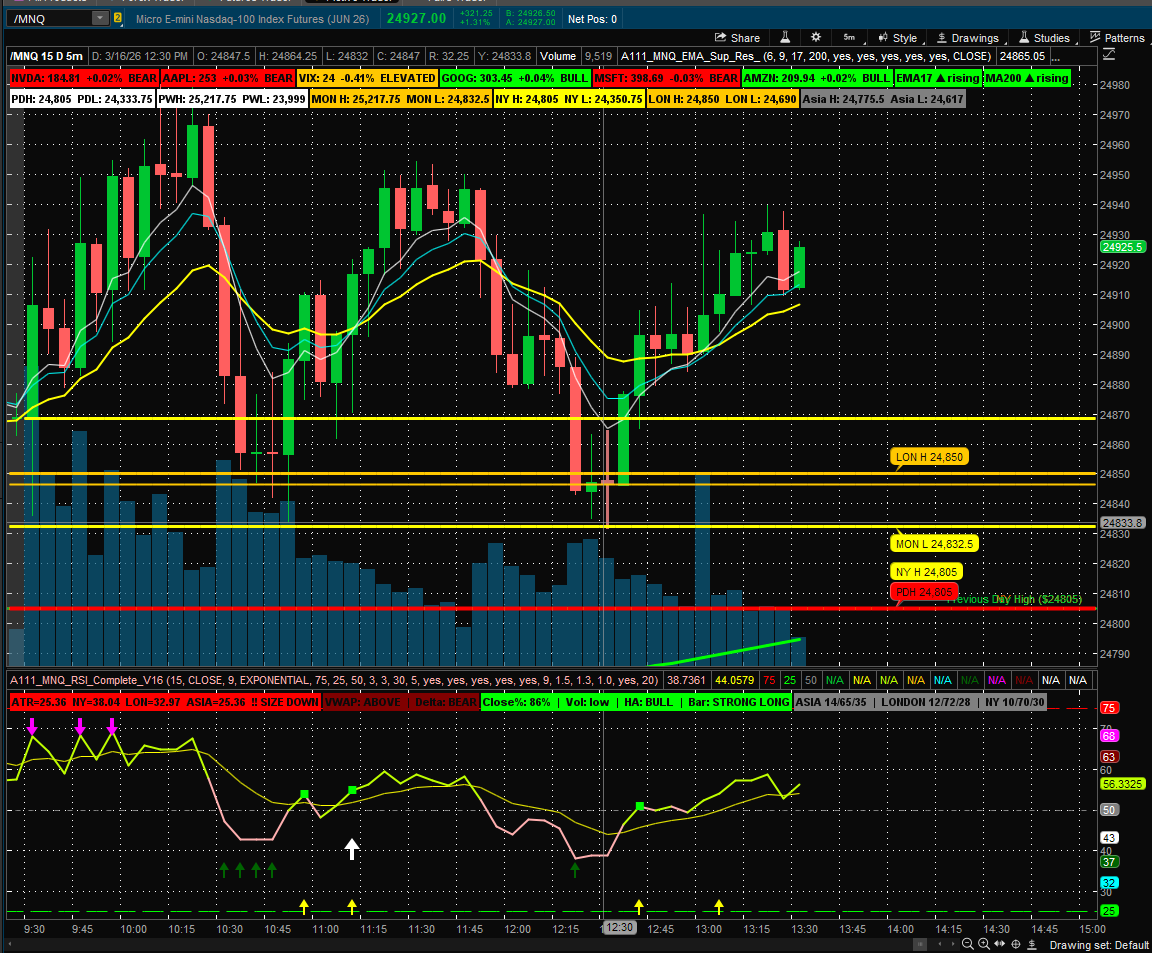
This guide documents every component of the MNQ RSI Complete V16 indicator system — what each element tracks, how to read it, how the layers interact, and how to use the complete system to find high-probability trade setups on MNQ futures. The System Philosophy: No single indicator tells the whole story. This system uses three independent layers of confirmation — institutional bias (Layer 1), momentum exhaustion (Layer 2), and bar-level strength (Layer 3). A trade is only taken when all three layers agree. When they disagree, you wait.
The ATR label (Row 1) is not a confirmation layer — it is a mandatory risk management tool. SIZE DOWN warnings override all other signals regardless of how perfect the setup looks. 2. The RSI Line and Signal Line (Layer 2) The RSI (Relative Strength Index) measures the speed and magnitude of recent price movements on a 0-100 scale. It does not predict direction — it measures exhaustion. When the market has moved too far too fast, RSI reaches extreme levels and signals that a reversal or pause is likely.
The yellow line is an EMA of the RSI — a smoothed, slower version that filters bar-to-bar noise. It shows the underlying momentum trend rather than the current reading.
Cloud fills shade the OB and OS zones for visual reinforcement. A dark red cloud appears when RSI is above OB, a dark green cloud when below OS. Extreme readings alone are not trade signals — they set the stage for signal arrows to fire. 3. Signal Arrows — Layer 2 Signals. All Layer 2 signals appear as colored arrows with no text labels. Color and size communicate everything. Arrows stack in rows above the OS line for longs and below the OB line for shorts. The further from the OB/OS line, the stronger the signal confidence.
A filled square appears directly ON the RSI line (at the exact RSI value) when 2 or more of the 3 system layers agree with the signal. Green square = long confirmation. Red square = short confirmation. A square alongside an arrow is one of the highest quality setups the system produces. 4. Divergence — The Core Edge. Divergence occurs when price and RSI move in opposite directions simultaneously. It is reliable because it reveals that the underlying momentum is disconnecting from price — the move is running on empty even as it continues pushing in one direction.
True tick-level delta requires order flow data that TOS ThinkScript does not expose. The indicator approximates delta using bar close position weighted by volume — a reliable proxy used by many professional tools. How it works: Each bar is evaluated for where it closed within its range. A bar closing near the high means buyers won that bar. A bar closing near the low means sellers won. Each result is weighted by that bar's volume, then smoothed with a 10-bar EMA to produce a directional bias reading.
Using VWAP and Delta together: The strongest Layer 1 readings occur when both agree. VWAP ABOVE + Delta BULL STRONG = powerful institutional buying bias. VWAP BELOW + Delta BEAR STRONG = powerful institutional selling bias. When they disagree, Layer 1 is mixed — require stronger confirmation from Layers 2 and 3 before entering. 6. Layer 3 — Bar Strength Confirmation. Layer 3 replaces DOM (order book) confirmation that futures traders normally use to validate entries. Without live order book data, three bar-level measurements collectively answer: did buyers actually dominate this specific bar? Strong DOM bids show up as bars closing near their highs on above-average volume.
Volume confirmation fires when the current bar's volume exceeds 1.2 times the 20-bar average volume. High-volume bars represent genuine institutional participation. Low-volume signals are inherently suspect because they may just be noise in a thin market. Vol: CONFIRM — volume above 120% of average. The bar has institutional backing. Vol: low — volume below threshold. The signal lacks conviction. Weight it accordingly. The indicator calculates Heikin Ashi (HA) candle values internally and uses them as a trend smoothing filter. HA candles average the open, high, low, and close across bars to filter single-bar noise and reveal the cleaner underlying directional trend. HA: BULL — HA close is above HA open on this bar. Smoothed price trending up. HA: BEAR — HA close is below HA open on this bar. Smoothed price trending down.
Why session-adjusted stops matter: MNQ behaves very differently across sessions. A 10-point stop during Asia might be reasonable while the same stop during a volatile NY session gets swept routinely. The multipliers are calibrated to each session's typical volatility profile so your stop is always proportional to the market's actual movement. 8. Complete Trade Setup Examples. These examples show how all three layers work together in practice. Remember: every layer you skip is a filter you removed from your system's edge. The more layers that confirm, the higher your probability.
If Layer 1 is mixed (e.g. VWAP ABOVE but Delta BEAR) and Layers 2 and 3 are both strongly bullish, you may consider a half-size trade. Never trade on Layer 2 alone no matter how strong or clean the RSI signal appears.
| Document Title | System Name | Platform |
|---|---|---|
| MNQ RSI Complete V16 Complete Trading System Reference Guide | ThinkScript Indicator Suite | ThinkorSwim | MNQ Futures Scalping |
This guide documents every component of the MNQ RSI Complete V16 indicator system — what each element tracks, how to read it, how the layers interact, and how to use the complete system to find high-probability trade setups on MNQ futures. The System Philosophy: No single indicator tells the whole story. This system uses three independent layers of confirmation — institutional bias (Layer 1), momentum exhaustion (Layer 2), and bar-level strength (Layer 3). A trade is only taken when all three layers agree. When they disagree, you wait.
| Layer | What It Measures | Source in Indicator | Bullish When |
|---|---|---|---|
| Layer 1 | Institutional bias — are big players buying or selling? | VWAP + Volume Delta label (Row 2 of label bar) | VWAP: ABOVE and Delta: BULL or BULL STRONG |
| Layer 2 | Momentum exhaustion — is the move running out of steam? | RSI arrows and signal line (main indicator body) | RSI crosses OS, bullish divergence fires, or white confluence arrow appears |
| Layer 3 | Bar-level strength — did buyers actually win this bar? | Bar strength label (Row 3 of label bar) | Close% above 60%, Vol: CONFIRM, HA: BULL, Bar: STRONG LONG |
The ATR label (Row 1) is not a confirmation layer — it is a mandatory risk management tool. SIZE DOWN warnings override all other signals regardless of how perfect the setup looks. 2. The RSI Line and Signal Line (Layer 2) The RSI (Relative Strength Index) measures the speed and magnitude of recent price movements on a 0-100 scale. It does not predict direction — it measures exhaustion. When the market has moved too far too fast, RSI reaches extreme levels and signals that a reversal or pause is likely.
| Color | Zone | Meaning |
|---|---|---|
| RED | At or above OB (70) | Overbought. Buyers may be exhausted. Watch for A Short or bearish divergence signals. |
| GREEN | At or below OS (30) | Oversold. Sellers may be exhausted. Watch for A Long or bullish divergence signals. |
| LIME | Between 50 and OB | Bullish territory. Momentum is positive. Favor longs on pullbacks to the signal line. |
| PINK | Between OS and 50 | Bearish territory. Momentum is negative. Favor shorts on bounces to the signal line. |
The yellow line is an EMA of the RSI — a smoothed, slower version that filters bar-to-bar noise. It shows the underlying momentum trend rather than the current reading.
| Condition | Momentum Reading |
|---|---|
| RSI above signal line | Momentum accelerating. The move has fuel behind it. |
| RSI below signal line | Momentum decelerating. The move is losing steam. |
| Lines converging | Momentum stalling. Often precedes reversal or consolidation. |
| Lines wide apart | Strong directional momentum in play — ride it. |
| Line | Default Level | Purpose |
|---|---|---|
| OB Line | 70 | Overbought threshold. A Short signals fire when RSI crosses below this line from above. |
| OS Line | 30 | Oversold threshold. A Long signals fire when RSI crosses above this line from below. |
| Mid Line | 50 | Neutral midline. RSI above 50 = bullish bias for trend filtering. Below 50 = bearish bias. |
Cloud fills shade the OB and OS zones for visual reinforcement. A dark red cloud appears when RSI is above OB, a dark green cloud when below OS. Extreme readings alone are not trade signals — they set the stage for signal arrows to fire. 3. Signal Arrows — Layer 2 Signals. All Layer 2 signals appear as colored arrows with no text labels. Color and size communicate everything. Arrows stack in rows above the OS line for longs and below the OB line for shorts. The further from the OB/OS line, the stronger the signal confidence.
| Row | Color and Weight | Signal Type | What It Means |
|---|---|---|---|
| +3 | YELLOW weight 2 | Mid Bounce | RSI crossed the 50 midline. Weakest signal — trend continuation only. Skip entirely in sideways or choppy markets. |
| +3 | LIME weight 4 | A Long | RSI crossed above the OS line (30). Classic oversold exhaustion. Sellers ran out of firepower and buyers stepped in. |
| +7 | CYAN weight 3 | Reg Bull Div | Regular bullish divergence. Price made a lower low but RSI made a higher low. Sellers losing momentum — reversal signal. |
| +12 | DARK GREEN wt 2 | Hidden Bull Div | Hidden bullish divergence. Price made a higher low but RSI dipped lower. Pullback in uptrend is over — continuation signal. |
| +18 | WHITE weight 5 | Confluence A+B | An A signal and a divergence both occurred within 5 bars of each other. Highest confidence long setup on the indicator. |
| Row | Color and Weight | Signal Type | What It Means |
|---|---|---|---|
| -3 | ORANGE weight 4 | A Short | RSI crossed below the OB line (70). Classic overbought exhaustion. Buyers ran out of firepower and sellers stepped in. |
| -7 | MAGENTA weight 3 | Reg Bear Div | Regular bearish divergence. Price made a higher high but RSI made a lower high. Buyers losing momentum — reversal signal. |
| -12 | DARK RED weight 2 | Hidden Bear Div | Hidden bearish divergence. Price made a lower high but RSI bounced higher. Bounce in downtrend is over — continuation signal. |
| -18 | WHITE weight 5 | Confluence A+B | An A signal and a divergence both occurred within 5 bars. Highest confidence short setup on the indicator. |
A filled square appears directly ON the RSI line (at the exact RSI value) when 2 or more of the 3 system layers agree with the signal. Green square = long confirmation. Red square = short confirmation. A square alongside an arrow is one of the highest quality setups the system produces. 4. Divergence — The Core Edge. Divergence occurs when price and RSI move in opposite directions simultaneously. It is reliable because it reveals that the underlying momentum is disconnecting from price — the move is running on empty even as it continues pushing in one direction.
| Divergence Type | Price Action | RSI Action | Interpretation |
|---|---|---|---|
| Regular Bullish (Cyan Arrow) | Price makes a lower low — downtrend appears to be continuing. | RSI makes a higher low at the same time — momentum is actually improving. | Sellers are still pushing price down but with less force each time. RSI exposes the declining energy. A reversal upward is the most probable next move. |
| Regular Bearish (Magenta Arrow) | Price makes a higher high — uptrend appears to be continuing. | RSI makes a lower high at the same time — momentum is actually weakening. | Buyers are still pushing price up but with less force. RSI exposes the declining energy. A reversal downward is the most probable next move. |
| Hidden Bullish (Dark Green Arrow) | Price makes a higher low — a healthy pullback within an established uptrend. | RSI makes a lower low — dips further than the price action suggests. | The pullback is a shakeout, not a trend reversal. The uptrend is intact and RSI is being temporarily misled. Price should resume the uptrend. |
| Hidden Bearish (Dark Red Arrow) | Price makes a lower high — a bounce within an established downtrend. | RSI makes a higher high — bounces stronger than the price action suggests. | The bounce is a bull trap, not a trend reversal. The downtrend is intact. RSI is temporarily misleading. Price should resume the downtrend. |
- Layer 1 — VWAP and Volume Delta. Layer 1 answers the most important question in futures trading: which side are the institutions on right now? VWAP and volume delta are the two most widely-used institutional reference points in professional trading desks worldwide. VWAP is the average price of every trade during the session, weighted by volume. It resets at each market open. Institutional algorithms use it as their benchmark — they evaluate fills against it and use it to determine whether price is expensive or cheap relative to the day's fair value.
| VWAP Reading | Market Meaning | Trade Bias |
|---|---|---|
| Price ABOVE VWAP | Market trading at a premium to fair value. Buyers in control. Institutions willing to pay up for exposure. | Favor LONGS. Look for A Long and bullish divergence signals from Layer 2. |
| Price BELOW VWAP | Market trading at a discount to fair value. Sellers in control. Institutions selling into any bounce. | Favor SHORTS. Look for A Short and bearish divergence signals from Layer 2. |
| Price crossing VWAP | Potential momentum shift in progress. Either side gaining or losing control. | Neutral until confirmed. Wait for a retest of VWAP and a directional bounce with Delta agreement. |
True tick-level delta requires order flow data that TOS ThinkScript does not expose. The indicator approximates delta using bar close position weighted by volume — a reliable proxy used by many professional tools. How it works: Each bar is evaluated for where it closed within its range. A bar closing near the high means buyers won that bar. A bar closing near the low means sellers won. Each result is weighted by that bar's volume, then smoothed with a 10-bar EMA to produce a directional bias reading.
| Delta Reading | What It Means | Confidence |
|---|---|---|
| BULL STRONG | Multiple recent high-volume bars closed near their highs. Strong sustained institutional buying pressure. | Highest — use as primary Layer 1 confirmation for longs |
| BULL | Recent bars leaning bullish. Moderate buying pressure present. | Moderate — supports longs but require stronger Layer 2 signal |
| BEAR | Recent bars leaning bearish. Moderate selling pressure present. | Moderate — supports shorts but require stronger Layer 2 signal |
| BEAR STRONG | Multiple recent high-volume bars closed near their lows. Strong sustained institutional selling pressure. | Highest — use as primary Layer 1 confirmation for shorts |
Using VWAP and Delta together: The strongest Layer 1 readings occur when both agree. VWAP ABOVE + Delta BULL STRONG = powerful institutional buying bias. VWAP BELOW + Delta BEAR STRONG = powerful institutional selling bias. When they disagree, Layer 1 is mixed — require stronger confirmation from Layers 2 and 3 before entering. 6. Layer 3 — Bar Strength Confirmation. Layer 3 replaces DOM (order book) confirmation that futures traders normally use to validate entries. Without live order book data, three bar-level measurements collectively answer: did buyers actually dominate this specific bar? Strong DOM bids show up as bars closing near their highs on above-average volume.
| Close% | Bar Label | Meaning |
|---|---|---|
| Above 60% | Strong bull bar | Buyers controlled the bar from start to finish and held the gains into the close. Equivalent to seeing bid stacking hold on a live DOM. |
| 40% to 60% | Mixed | Neither side dominated. The bar is indecisive. This is the weakest possible Layer 3 confirmation — do not rely on it alone. |
| Below 40% | Strong bear bar | Sellers controlled the bar and pushed price down into the close. Equivalent to seeing offer stacking dominate on a live DOM. |
Volume confirmation fires when the current bar's volume exceeds 1.2 times the 20-bar average volume. High-volume bars represent genuine institutional participation. Low-volume signals are inherently suspect because they may just be noise in a thin market. Vol: CONFIRM — volume above 120% of average. The bar has institutional backing. Vol: low — volume below threshold. The signal lacks conviction. Weight it accordingly. The indicator calculates Heikin Ashi (HA) candle values internally and uses them as a trend smoothing filter. HA candles average the open, high, low, and close across bars to filter single-bar noise and reveal the cleaner underlying directional trend. HA: BULL — HA close is above HA open on this bar. Smoothed price trending up. HA: BEAR — HA close is below HA open on this bar. Smoothed price trending down.
| Overall Bar Rating | Requirement | Meaning |
|---|---|---|
| STRONG LONG | At least 2 of the 3 components show bullish readings. | High probability bullish bar strength. |
| STRONG SHORT | At least 2 of the 3 components show bearish readings. | High probability bearish bar strength. |
| Mixed | Conflicting signals. | Treat as no Layer 3 confirmation. |
- ATR Label — Volatility and Risk Sizing. The ATR (Average True Range) label updates every bar and tells you exactly how wide your stop needs to be given current market conditions. It is not optional — the SIZE DOWN warning overrides every other signal in the system.
| Field | Calculation | How to Use It |
|---|---|---|
| ATR | Average True Range over 9 bars | Raw volatility. Larger number means the market is moving more per bar — stops need to be wider. |
| NY Stop | ATR multiplied by 1.5 | Place your hard stop this many points from entry during NY session. Maximum allowed is 20 points. |
| LON Stop | ATR multiplied by 1.3 | Stop distance for London session. Slightly lower multiplier — London is less volatile than NY. |
| ASIA Stop | ATR multiplied by 1.0 | Stop distance for Asia session. Minimum multiplier — Asia is the quietest and slowest session. |
| SIZE DOWN | NY Stop exceeds 20 pts | CRITICAL. Cut position size by 50% minimum. Full-size trades in high-ATR conditions destroy accounts. |
Why session-adjusted stops matter: MNQ behaves very differently across sessions. A 10-point stop during Asia might be reasonable while the same stop during a volatile NY session gets swept routinely. The multipliers are calibrated to each session's typical volatility profile so your stop is always proportional to the market's actual movement. 8. Complete Trade Setup Examples. These examples show how all three layers work together in practice. Remember: every layer you skip is a filter you removed from your system's edge. The more layers that confirm, the higher your probability.
| Check | What You See | Result | |
|---|---|---|---|
| ATR First | ATR label is green, NY stop is under 20 points | PASS — safe to trade full size | |
| Layer 1 | VWAP: ABOVE and Delta: BULL or BULL STRONG in Row 2 | PASS — institutions are buying | |
| Layer 2 | Lime A Long arrow fires (or Cyan divergence or White confluence) | PASS — RSI confirms seller exhaustion | |
| Layer 3 | Close%: 65%+, Vol: CONFIRM, HA: BULL, Bar: STRONG LONG in Row 3 | PASS — buyers dominated this specific bar | |
| Bonus | Green confirmation square appears on RSI line at this bar | BONUS — system already counted 2+ layers agreeing |
If Layer 1 is mixed (e.g. VWAP ABOVE but Delta BEAR) and Layers 2 and 3 are both strongly bullish, you may consider a half-size trade. Never trade on Layer 2 alone no matter how strong or clean the RSI signal appears.
| Situation | Why to Skip |
|---|---|
| SIZE DOWN warning is active | Risk is structurally too high. Even perfect signals fail when stops must be 30+ points wide. |
| Within 15 minutes of major economic news | News events can gap price through your stop in a single tick. No edge exists around high-impact releases. |
| RSI bouncing off OS repeatedly in downtrend | RSI can remain oversold for many bars in strong trends. You are trying to catch a falling knife. |
| Layer 1 strongly against your direction | Trading against institutional flow is the most common way retail traders give back profits. Skip and wait. |
| No volume confirmation on Layer 3 | Low-volume signals are likely noise. The smart money is not participating in the move. |
| Hidden divergence against higher TF trend | Hidden divergence only works with the prevailing trend. Against it, you are just fading momentum. |
| Session | RSI Length | OB Level | OS Level | ATR Mult | Max Trades | Notes |
|---|---|---|---|---|---|---|
| NY 9:30AM-4PM ET | 10 | 70 | 30 | 1.5x | 3 | Highest volatility and volume. Most reliable signals. Primary trading session. |
| London 3AM-8AM ET | 12 | 72 | 28 | 1.3x | 2 | Good trend days. Divergence signals work well. Moderate volatility. |
| Asia 7PM-2AM ET | 14 | 65 | 35 | 1.0x | 2 | Slow and choppy. Wider OS/OB avoids false signals in thin conditions. |
| Setting | Default | What Changing It Does |
|---|---|---|
| rsi_length | 10 | Number of bars in RSI. Lower = more signals, noise. Higher = fewer, lag. Change by session: NY=10, Lon=12, Asia=14. |
| rsi_price | close | Price fed into RSI. Close is standard. HL2 or HLC3 give marginally smoother readings. |
| smooth_length | 7 | EMA length for yellow signal line. Higher = more lag. Lower = immediate response. |
| smooth_type | EXPONENTIAL | Moving average type. EXPONENTIAL weights recent bars more heavily. SIMPLE weights all equally. |
| ob_level | 70 | Overbought threshold. Raise to 72 for London, lower to 65 for Asia. |
| os_level | 30 | Oversold threshold. Lower to 28 for London, raise to 35 for Asia. |
| mid_level | 50 | Midline for color zone separation and mid-bounce detection. Rarely needs adjustment. |
| lookback_left | 3 | Bars to the LEFT of pivot. Higher = major pivots. Lower = minor pivots. |
| lookback_right | 3 | Bars to the RIGHT of pivot. Higher = more confirmation, fires later. Lower = earlier, noise. |
| max_lookback | 30 | How far back to look for prior swing. Higher = long-term. Lower = short-term. |
| conf_window | 5 | Bars apart A signal and divergence can be for confluence. Higher = more signals, lower quality. |
| atr_length | 9 | Bars for ATR. Higher = stable volatility reading. Lower = faster changing. |
| atr_mult_ny | 1.5 | Stop distance multiplier for NY. Increase if stopped out on valid setups. |
| vol_avg_length | 20 | Bars for average volume threshold calculation. |
| show_arrows | yes | Master toggle for all arrow signals. Useful for viewing RSI lines only. |
| Signal | Color | Dir | Confidence | Action |
|---|---|---|---|---|
| Mid Bounce | Yellow arrow | L | Weakest | Trend continuation only. Skip in sideways or choppy conditions. |
| A Long | Lime arrow wt 4 | L | Moderate | OS cross. Wait for Layer 1 and Layer 3 confirmation before entering. |
| Reg Bull Div | Cyan arrow wt 3 | L | Mod-High | Reversal signal. Best at support with Layer 1 bullish agreement. |
| Hidden Bull Div | Dk Green wt 2 | L | Continuation | Pullback entry in uptrend. Requires clear higher timeframe uptrend. |
| Confluence Long | White arrow wt 5 | L | Strongest | A signal + divergence within 5 bars. Highest priority long setup. |
| A Short | Orange arrow wt 4 | S | Moderate | OB cross. Wait for Layer 1 and Layer 3 confirmation before entering. |
| Reg Bear Div | Magenta arrow wt 3 | S | Mod-High | Reversal signal. Best at resistance with Layer 1 bearish agreement. |
| Hidden Bear Div | Dark Red wt 2 | S | Continuation | Bounce entry in downtrend. Requires clear higher timeframe downtrend. |
| Confluence Short | White arrow wt 5 | S | Strongest | A signal + divergence within 5 bars. Highest priority short setup. |
| Green Square | On RSI line | L | 2+ layers | Strong confirmation. Best entries combine square and arrow together. |
| Red Square | On RSI line | S | 2+ layers | Strong confirmation. Best entries combine square and arrow together. |
Last edited by a moderator: