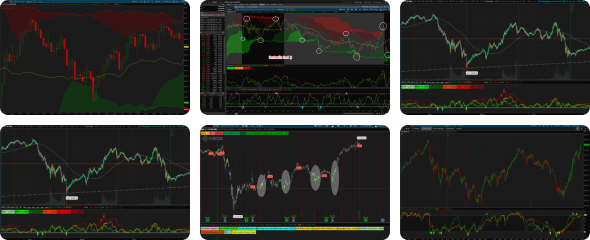
This set-up only has three studies.
mod note:
The chart uses advanced mathematical filters to "smooth" price action, making it easier to see the true direction of the stock without the "noise" of small, random price movements.
Shared Chart Link: http://tos.mx/!D9tlMlxj
Using the ATR Bands for Exits
The bands (UB1-UB3 and LB1-LB3) are your "target zones".
Best Practices
Wait for the Cross:
1) MACD & RSI Overlay
2) Double Pass Auto-Adjusting Kalman Filter
3) Triple Pass Kalman Filter
Hope it helps.mod note:
The chart uses advanced mathematical filters to "smooth" price action, making it easier to see the true direction of the stock without the "noise" of small, random price movements.
Shared Chart Link: http://tos.mx/!D9tlMlxj
| Signal | Bullish (Buy/Long) | Bearish (Sell/Short) |
|---|---|---|
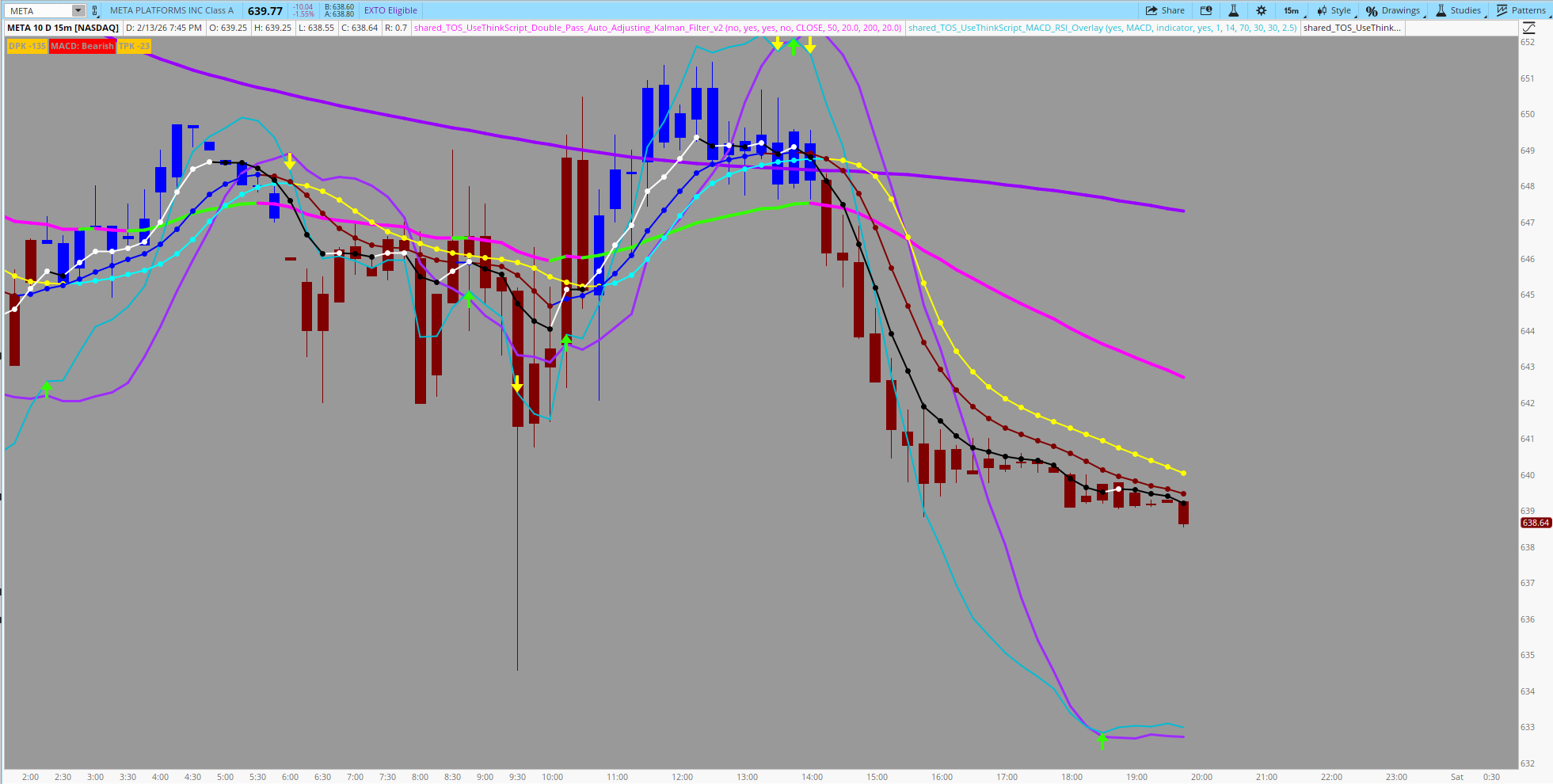
| Price Color | Bars turn Blue (Kalman1 > Kalman3) +1 | Bars turn Dark Red (Kalman1 < Kalman3) +1 |
| Trend Labels | DPK/TPK labels are Cyan with positive numbers +1 | DPK/TPK labels are Orange with negative numbers +1 |
| Momentum | MACD/RSI labels turn Green | MACD/RSI labels turn Red |
Using the ATR Bands for Exits
The bands (UB1-UB3 and LB1-LB3) are your "target zones".
If you are in a Long trade and the price hits the Yellow Upper Band (UB2), consider taking profits.
If you are in a Short trade and the price hits the Yellow Lower Band (LB2), consider covering your position.
Best Practices
Wait for the Cross:
Don't jump in at the first sign of a color change. Wait for the Kalman lines to clearly cross and for the labels to confirm the direction.
Respect the Labels:The labels in the top left act as a "dashboard." If they aren't all the same color, the market is likely "choppy," and it's best to stay on the sidelines.
Watch the Slope:The steepness of the Kalman lines indicates trend strength. A flat line means the stock is range-bound; a steep line means a strong trend is underway.
Last edited by a moderator: