We've all been there. Trading is a psychosis. I get paranoid if a trade loses and change my direction. I get schizophrenic and change just for change's sake. What if that is a strategy???
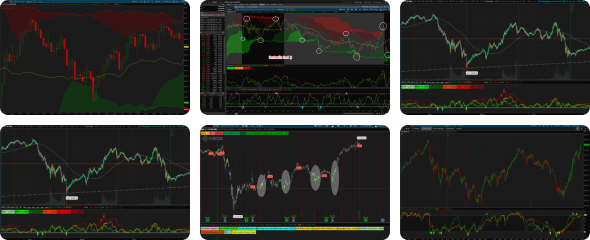
On SPX, with the inputs (Close, 0.5, 7, 3, 1). 1 day time frame.
Chart shows it up 15% in 90 days (win rate 87%), 25% in last year (win rate 68%).
This assumes you're always in the market, long or short.
When looking at prior years, the study is breakeven to not great. Although I haven't analyzed the best inputs.
Enjoy!

Since Gemini helped me make the the study, I'll let them describe the technical bits.
This study, titled The Paranoid-Schizophrenic Kalman, is a sophisticated trend-following system that uses adaptive signal processing to navigate market volatility. At its core, it employs a Kalman Filter, a mathematical algorithm often used in aerospace and navigation, to "denoise" price action. Unlike a standard moving average, the Kalman engine dynamically adjusts its responsiveness based on the signal's error rate, providing a smoother, more accurate representation of the trend (the Cyan/Magenta Signal Line) while reducing the lag typically found in traditional indicators.
What makes this study unique is its "Logic-Flip" State Machine. Rather than strictly buying when the trend is up, the engine monitors its own performance in real-time. If a trade results in a loss or exceeds a specific time limit (MaxBarsBeforeFlip), the system assumes the current market regime has shifted and "inverts" its logic. In "Standard" mode, it follows the trend; in "Inverted" mode, it contrarian-trades against the trend. This self-correcting DNA allows the study to automatically pivot between trend-following and mean-reversion strategies based on historical success, aiming to stay on the right side of shifting market cycles.
On SPX, with the inputs (Close, 0.5, 7, 3, 1). 1 day time frame.
Chart shows it up 15% in 90 days (win rate 87%), 25% in last year (win rate 68%).
This assumes you're always in the market, long or short.
When looking at prior years, the study is breakeven to not great. Although I haven't analyzed the best inputs.
Enjoy!
Since Gemini helped me make the the study, I'll let them describe the technical bits.
This study, titled The Paranoid-Schizophrenic Kalman, is a sophisticated trend-following system that uses adaptive signal processing to navigate market volatility. At its core, it employs a Kalman Filter, a mathematical algorithm often used in aerospace and navigation, to "denoise" price action. Unlike a standard moving average, the Kalman engine dynamically adjusts its responsiveness based on the signal's error rate, providing a smoother, more accurate representation of the trend (the Cyan/Magenta Signal Line) while reducing the lag typically found in traditional indicators.
What makes this study unique is its "Logic-Flip" State Machine. Rather than strictly buying when the trend is up, the engine monitors its own performance in real-time. If a trade results in a loss or exceeds a specific time limit (MaxBarsBeforeFlip), the system assumes the current market regime has shifted and "inverts" its logic. In "Standard" mode, it follows the trend; in "Inverted" mode, it contrarian-trades against the trend. This self-correcting DNA allows the study to automatically pivot between trend-following and mean-reversion strategies based on historical success, aiming to stay on the right side of shifting market cycles.
Key Components
| Component | Technical Function |
| Kalman Engine | Uses a recursive state-space model to filter price noise and track the "true" trend with minimal lag. |
| State Machine | A logic gate that tracks entry prices, bar counts, and wins/losses to dictate the next move. |
| Logic Flip | An adaptive mechanism that toggles the strategy between Standard (Trend) and Inverted (Counter-Trend) modes. |
| Profit Engine | A real-time accounting module that calculates cumulative P/L and per-trade performance. |
Code:
# THE CRAZY TRAIN AKA PARANOIA-SCHIZOPHERENIA
# APPLIED TO A KALMAN TREND
# -----------------------------------------------
input src = close;
input KalmanGain = 0.5;
input Signal_Length = 70;
input MaxBarsBeforeFlip = 40;
input UnitsTraded = 1;

# --- 1. KALMAN ENGINE ---
rec Kalman_Estimate;
rec Kalman_Error;
def Prev_Est = if IsNaN(Kalman_Estimate[1]) then src else Kalman_Estimate[1];
def Prev_Err = if IsNaN(Kalman_Error[1]) then 1 else Kalman_Error[1] + 0.1;
def K_Gain = Prev_Err / (Prev_Err + KalmanGain);
Kalman_Estimate = Prev_Est + K_Gain * (src - Prev_Est);
Kalman_Error = (1 - K_Gain) * Prev_Err;

plot SignalLine = Average(Kalman_Estimate, Signal_Length);
SignalLine.AssignValueColor(if SignalLine > SignalLine[1] then Color.CYAN else Color.MAGENTA);
SignalLine.SetLineWeight(3);

# --- 2. TREND DETECTION ---
def curlUp = SignalLine > SignalLine[1] and SignalLine[1] <= SignalLine[2];
def curlDown = SignalLine < SignalLine[1] and SignalLine[1] >= SignalLine[2];

# --- 3. THE STATE MACHINE ---
rec CurrentPosition;
rec IsInverted;
rec EntryPrice;
rec BarsInTrade;

# Step A: Did the previous trade close?
def tradeClosed = CurrentPosition[1] != 0 and (curlUp or curlDown or BarsInTrade[1] >= MaxBarsBeforeFlip);
def lastTradeProfit = if tradeClosed then (if CurrentPosition[1] == 1 then close - EntryPrice[1] else EntryPrice[1] - close) else 0;
def wasLoss = tradeClosed and lastTradeProfit < 0;

# Step B: Update Logic DNA (Flip on Loss or Time)
IsInverted = if BarNumber() <= Signal_Length then 1
             else if wasLoss or (BarsInTrade[1] >= MaxBarsBeforeFlip) then !IsInverted[1]
             else IsInverted[1];

# Step C: Determine Position
if (BarNumber() < Signal_Length) {
    CurrentPosition = 0;
    EntryPrice = close;
    BarsInTrade = 0;
} else {
    if (tradeClosed or CurrentPosition[1] == 0) {
        CurrentPosition = if IsInverted then (if SignalLine > SignalLine[1] then -1 else 1)
                                        else (if SignalLine > SignalLine[1] then 1 else -1);
        EntryPrice = close;
        BarsInTrade = 1;
    } else {
        CurrentPosition = CurrentPosition[1];
        EntryPrice = EntryPrice[1];
        BarsInTrade = BarsInTrade[1] + 1;
    }
}

# --- 4. PROFIT ENGINE & TRADE COUNTER ---
# We define isNewOrder based on the final state machine output
def isNewOrder = CurrentPosition != CurrentPosition[1] and CurrentPosition != 0;

# FIXED COUNTER: Only increments when a New Order signal is triggered
rec TradeCount = CompoundValue(1, if isNewOrder then TradeCount[1] + 1 else TradeCount[1], 0);

def barPips = if CurrentPosition[1] == 1 then close - close[1] else if CurrentPosition[1] == -1 then close[1] - close else 0;
rec totalCash = CompoundValue(1, totalCash[1] + (barPips * UnitsTraded), 0);

rec tradeAccumulator;
if isNewOrder {
    tradeAccumulator = 0; # Reset for new trade
} else {
    tradeAccumulator = tradeAccumulator[1] + (barPips * UnitsTraded);
}

# --- 5. VISUALS ---
# Note: The bubble shows the P/L of the trade that just CLOSED
AddChartBubble(isNewOrder and BarNumber() > Signal_Length, if CurrentPosition == 1 then low else high,
    AsDollars(tradeAccumulator[1]),
    if tradeAccumulator[1] >= 0 then Color.GREEN else Color.RED,
    if CurrentPosition == 1 then 0 else 1);

AddLabel(yes, "Logic: " + (if IsInverted then "INVERTED" else "STANDARD"), if IsInverted then Color.YELLOW else Color.WHITE);
AddLabel(yes, "Total Trades: " + TradeCount, Color.WHITE);
AddLabel(yes, "Session P/L: " + AsDollars(totalCash), if totalCash > 0 then Color.GREEN else Color.RED);