Boundary Condition. Starting a counter at Bar 1

sbhyde

New member
This is quite simple, I thought .. but this one is making be think this is VB6 all over again.

I am running a counter starting at bar 1. I don't always increment it but for this example I am. This is an isolated and simplifier example.
It did not include in the images, but the close price is different for each bar. You can look at the bars and see that. This should be easy to reproduce,

Code:
# MDLN  < use this symbol to easily get to bar #1

def pC = if BarNumber() == 1 then 1 else if (close == close[1]) then pC[1] else pC[1] + 1;

AddChartBubble(yes, high, BarNumber() + "  " + pC + "  " + isNAN(pC), Color.WHITE);

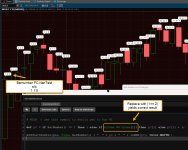
Despite the line assigning the counter the value of 1 when the Barnumber is 1 (BarNumber() == 1 then 1), the value in the counter is 0. The value is not NaN.
Attached is an image showing the code and the result.
Troubleshooting isolated the problem to (close == close[1]). If I replaced that expression with (1 == 2), I get the expected result.
Apparently even though the first condition of the if statement is true, it still evaluates close[1] which does not exist. But it does not produce an error.

I tried using CompoundValue like this

Code:
# MDLN  < use this symbol to easily get to bar #1

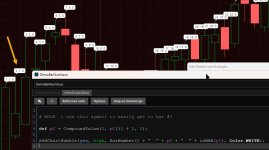
def pC = CompoundValue(1, pC[1] + 1, 1);

AddChartBubble(yes, high, BarNumber() + "  " + pC + "  " + isNAN(pC), Color.WHITE);

The counter initialized properly on bar 1, but it did not increment on bar 2. Proper incrementing started on bar 3. See images
Any thoughts would be appreciated
 

Attachments

  • BadCounterCV.jpg
    BadCounterCV.jpg
    127.8 KB · Views: 81
  • BadCounter.jpg
    BadCounter.jpg
    227.9 KB · Views: 72
Solution
The issue is that you're introducing a constant-driven offset [1] to a primary fundamental (OHLC, etc.) at the explicit beginning of the chart, where no data exists prior. I can explain it in greater detail if need be.

mNGxQCi.png


Code:
def pc =
    if barnumber() == 1 then 1
    else pc[1] + !(close == getvalue(close,1));

AddChartBubble(yes, high,
    BarNumber() + "  " + pC + "  " + isNAN(pC)
,Color.WHITE);

KE6wN1Y.png

🤣
The issue is that you're introducing a constant-driven offset [1] to a primary fundamental (OHLC, etc.) at the explicit beginning of the chart, where no data exists prior. I can explain it in greater detail if need be.

mNGxQCi.png


Code:
def pc =
    if barnumber() == 1 then 1
    else pc[1] + !(close == getvalue(close,1));

AddChartBubble(yes, high,
    BarNumber() + "  " + pC + "  " + isNAN(pC)
,Color.WHITE);

KE6wN1Y.png

🤣
 
Last edited by a moderator:
Solution
The issue is that you're introducing a constant-driven offset [1] to a primary fundamental (OHLC, etc.) at the explicit beginning of the chart, where no data exists prior. I can explain it in greater detail if need be.

mNGxQCi.png


Code:
def pc =
    if barnumber() == 1 then 1
    else pc[1] + !(close == getvalue(close,1));

AddChartBubble(yes, high,
    BarNumber() + "  " + pC + "  " + isNAN(pC)
,Color.WHITE);

KE6wN1Y.png

🤣

Joshua. I wanted to thank you for the reply and to create a record for others who might come across this problem.

I understand what you are saying. I am not having a problem on bar 1, when [1] has nothing to reference. I encountered the problem on bar 2, when [1] referenced the value in bar 1 which printed on the screen as 1. (just like VB6 - don't make no sence!)

CompoundValue(1, pC[1] + 1, 1) is supposed to use 1 for bar 1 and not evaluate pc[1] until the bar number is greater that 1. I thought this was the entire reason for the existence of CompoundValue, to protect the code from the starting boundary issues!

As a non-member my post was held for a week plus and I eventually went to ToS support. After an hour of discussion, they admitted this was a bug that only occured when evaluating the day after the first issue date and they placed it on the bug fix list. Fix date unknown.

I tried other approaches, trying to find a way around what appeared to be erroneous behavior.
I tried this
def pc = if BarNumber() == 1 then 1 else CompoundValue(1, pC[1] + 1, 1);
Didn't work. Neither did a few other things. At the time I didn't realize this was a bug deep in the CompoundValue function.

Your code works!
It would seem the solution is to stay away from the CompoundValue function.

Thank you....
 
A chart has two beginnings. One is when you've chosen to limit the span of visible data in your time frame settings by preference. The other is first issuance, this is the absolute beginning of the data.

Offsets introduce pre-fetch, this generates virtual bar numbers 0 through -N, incrementing leftward from the chart's first bar. The length of which is driven by maximum length offset present in the script. This allows calculations that involve a length of bars to display immediately.

Pre-fetch effects the entire script. One variable can begin calculating prematurely due to unintended pre-fetch from another variable. That's what compound value is for, primarily.

The same can be accomplished and surpassed free-hand though. Nobody really uses compound value. It's usually a sign of ai-spam, or more fittingly, of experienced programmers from other languages trying to be overly official with the syntax while first learning thinkscript.

However, the data must exist, such as beyond the span limit. Things behave strangely when pre-fetch overruns first issuance. The result isn't simply NaN as would be expected, it can be, but pre-fetch overrun posts a number of different return values based on context.

For example. Constants resolve to Self. Fundamental data, which is anything with a green identifier in the editor, resolves to NaN. Purely user defined variables resolve to zero. However, there seems to be an additional check involving recursion.

A entire variable definition can not include 1) an expression containing an offset fundamental reference, and 2) a recursive expression, both anywhere in the entire definition, while [n] overruns first issuance.

If that is the case, the entire definition resolves to zero. This rather unique check completely ignores the exclusivity of logical branches, individual expressions, and so forth.

I believe this is because of the fact that any expression involving NaN will always resolve to NaN itself outside of isNaN(). Therefore, otherwise, a recursive fundamental offset at first issuance would cascade NaN all the way down the entire chart.

So it sort of error-dumps it to zero.

def pC = if BarNumber() == 1 then 1 else if (close == close[1]) then pC[1] else pC[1] + 1;

Due to Close[1], and ... = pC[1], this entire definition resolves to zero while [1] overruns first issuance. The check for if BarNumber() == is not even considered until [n] overrun is exhausted.

Where as, in your (1 == 2) example, those are both constants, which resolve to self. There's no potential to recursively cascade NaN all the way down the chart, so it works.

The solution is to use GetValue() instead of offsets, unless you need intentional pre-fetch, or to simply delay all calculations until beyond max-offset length.
 

Join useThinkScript to post your question to a community of 21,000+ developers and traders.

Similar threads

Not the exact question you're looking for?

Start a new thread and receive assistance from our community.

87k+ Posts
2926 Online
Create Post

Similar threads

Similar threads

The Market Trading Game Changer

Join 2,500+ subscribers inside the useThinkScript VIP Membership Club
  • Exclusive indicators
  • Proven strategies & setups
  • Private Discord community
  • ‘Buy The Dip’ signal alerts
  • Exclusive members-only content
  • Add-ons and resources
  • 1 full year of unlimited support

Frequently Asked Questions

What is useThinkScript?

useThinkScript is the #1 community of stock market investors using indicators and other tools to power their trading strategies. Traders of all skill levels use our forums to learn about scripting and indicators, help each other, and discover new ways to gain an edge in the markets.

How do I get started?

We get it. Our forum can be intimidating, if not overwhelming. With thousands of topics, tens of thousands of posts, our community has created an incredibly deep knowledge base for stock traders. No one can ever exhaust every resource provided on our site.

If you are new, or just looking for guidance, here are some helpful links to get you started.

What are the benefits of VIP Membership?
VIP members get exclusive access to these proven and tested premium indicators: Buy the Dip, Advanced Market Moves 2.0, Take Profit, and Volatility Trading Range. In addition, VIP members get access to over 50 VIP-only custom indicators, add-ons, and strategies, private VIP-only forums, private Discord channel to discuss trades and strategies in real-time, customer support, trade alerts, and much more. Learn all about VIP membership here.
How can I access the premium indicators?
To access the premium indicators, which are plug and play ready, sign up for VIP membership here.
Back
Top